
What happened
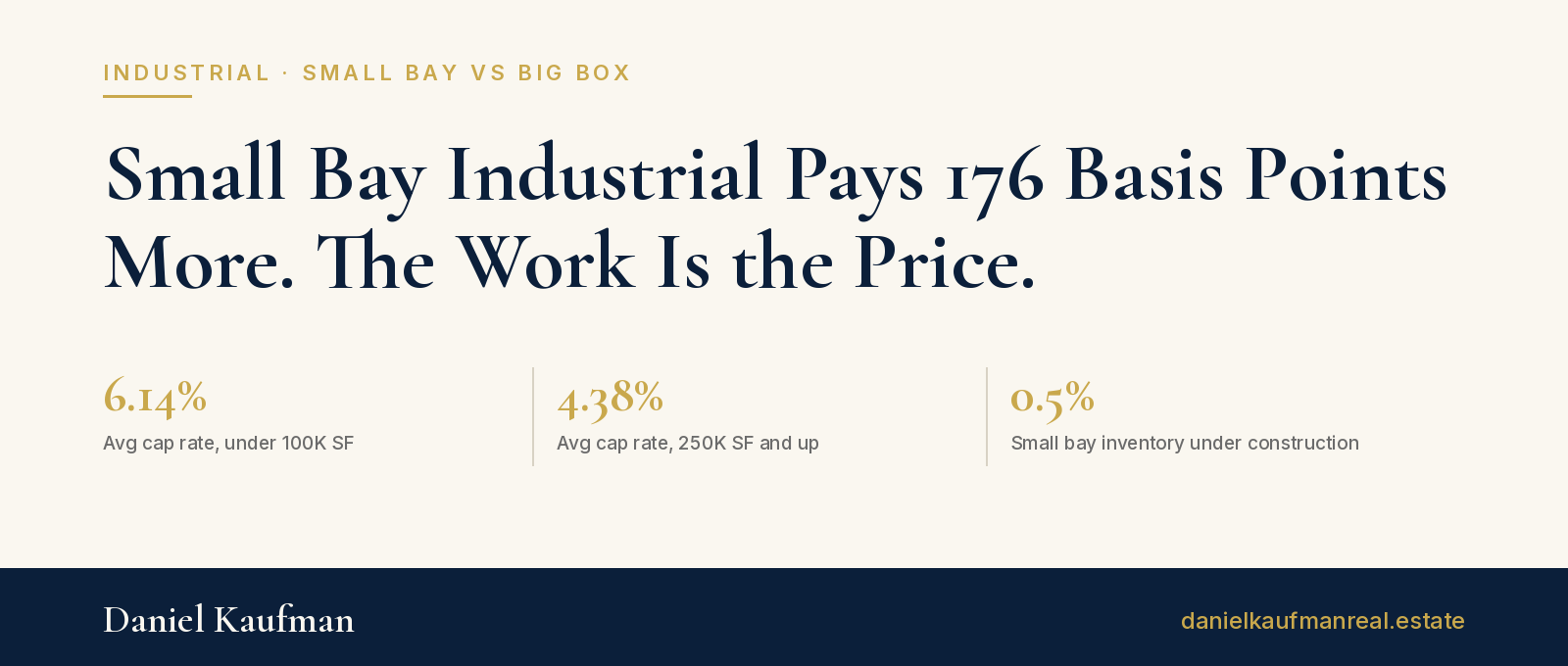
CRE Daily reported on an Altus Group analysis of 61 industrial sales across 36 metros, which found buildings under 100,000 square feet traded at an average 6.14% cap rate, against 4.38% for buildings of 250,000 square feet or more. That is a 176 basis point spread. Altus also saw the gap moving from roughly 169 basis points in 2025 to 192 basis points in 2026, but only seven large buildings sold in this year’s sample, so Altus treats that as a direction rather than a conclusion. I would too.
The same day, CRE Daily reported Cushman & Wakefield research showing companies that serve data centers took 14% of U.S. industrial leasing in the third quarter, up from about 5% in 2024 and 2025. Big box demand is picking up a new tenant class. Small bay runs on something older: the trades, local manufacturers, service firms and last mile operators that fill suites of roughly 2,000 to 15,000 square feet.
Where we see opportunity
Supply is the strongest argument. BKM data cited by Altus put just 0.5% of small bay inventory under construction in the third quarter, against 3.0% for large bay. Small buildings averaged 4.9% vacancy at the end of 2025, about half the large building rate at the time. Very little new small bay gets built, because land and construction costs make a multi tenant flex building hard to pencil at today’s rents. That scarcity protects existing owners.
The tenants are also the local economy. Electricians, mechanical contractors, cabinet shops and equipment suppliers expand when housing, factories and data centers get built nearby, and the small bay building down the road is where they set up. Leases of three to five years, against five to ten for many big warehouses, also reset to market faster. In a tight segment, that is upside.
Where we see the downfalls
The higher yield is not free money. Shorter leases mean more turnover, more downtime, more leasing commissions and more improvement dollars. A long tenant roster lowers concentration, but as Altus notes, it does not lower credit risk, and a building full of small businesses heading into a rate hike cycle deserves a hard look at who pays and who might not. An obsolete building in a weak location also does not become attractive just because nothing new is being built nearby. Clear heights, truck courts and power still matter.
The debt math is unforgiving too. Altus noted the 10 year Treasury went from about 4.5% at the start of June to 5.31% on October 5, and the median coupon on 10 year fixed rate loans in 2026 CMBS pools was about 6.3% by mid October. CRE Daily’s market snapshot had the 10 year at 4.93% at the November 24 close. With a cap rate near 6% and debt costing more than that, leverage adds little to the day one return. Altus also warns that the next buyer may discount for how management intensive these buildings are. This is a segment for owners who can operate and hold, not for buyers counting on cheap debt or a quick exit.
What we are watching
Three things. Whether the spread holds as more large building trades fill in the 2026 sample. Whether the data center supply chain starts moving into smaller suites as projects shift from construction to operations. And land. Because new small bay is so scarce, the real opportunity in many markets is the entitled infill industrial parcel near growing housing and employment, where a small multi tenant or owner user building can actually work. That is a site question before it is a capital markets question.
If you hold an infill industrial site or an older flex building and want an honest read on what it can become, our Site and Feasibility Review at Kaufman Real Estate & Consulting is built for exactly that question: https://www.kaufmanrealestateandconsulting.com.
From the newsroom: our latest release explains why slow CMBS workouts should bring a steady flow of reset office, hotel and mixed use assets, and the land beneath them, to patient owners, Family Office Founder Daniel Kaufman Says Aging CRE Distress Will Reward Patient Owners.
About the Author
I’m the founder and CEO of Kaufman & Company, a permanent capital holding company that buys land and existing assets across multifamily, hotels, resorts, industrial, commercial, mixed use, AI infrastructure and data centers, and builds and holds them for the long term. My focus is workforce housing and employer-anchored development, including mountain resort communities.
Reach me at Daniel@kaufmanredev.com or find more at danielkaufmanre.com.
Sources
Small-Bay Industrial Cap Rates Run 176 Bps Above Big-Box, CRE Daily, November 25, 2026, https://www.credaily.com/briefs/small-bay-industrial-cap-rates-run-176-bps-above-big-box/
Data Center Suppliers Now Drive 14% of Industrial Leasing, CRE Daily, November 25, 2026, https://www.credaily.com/briefs/data-center-suppliers-now-drive-14-of-industrial-leasing/
CMBS Special Servicing Backlog Ages as 43% of Loans Top Two Years, CRE Daily, November 25, 2026, https://www.credaily.com/newsletters/national/issue/cmbs-special-servicing-backlog-ages-as-43-of-loans-top-two-years/
Leave a Reply