
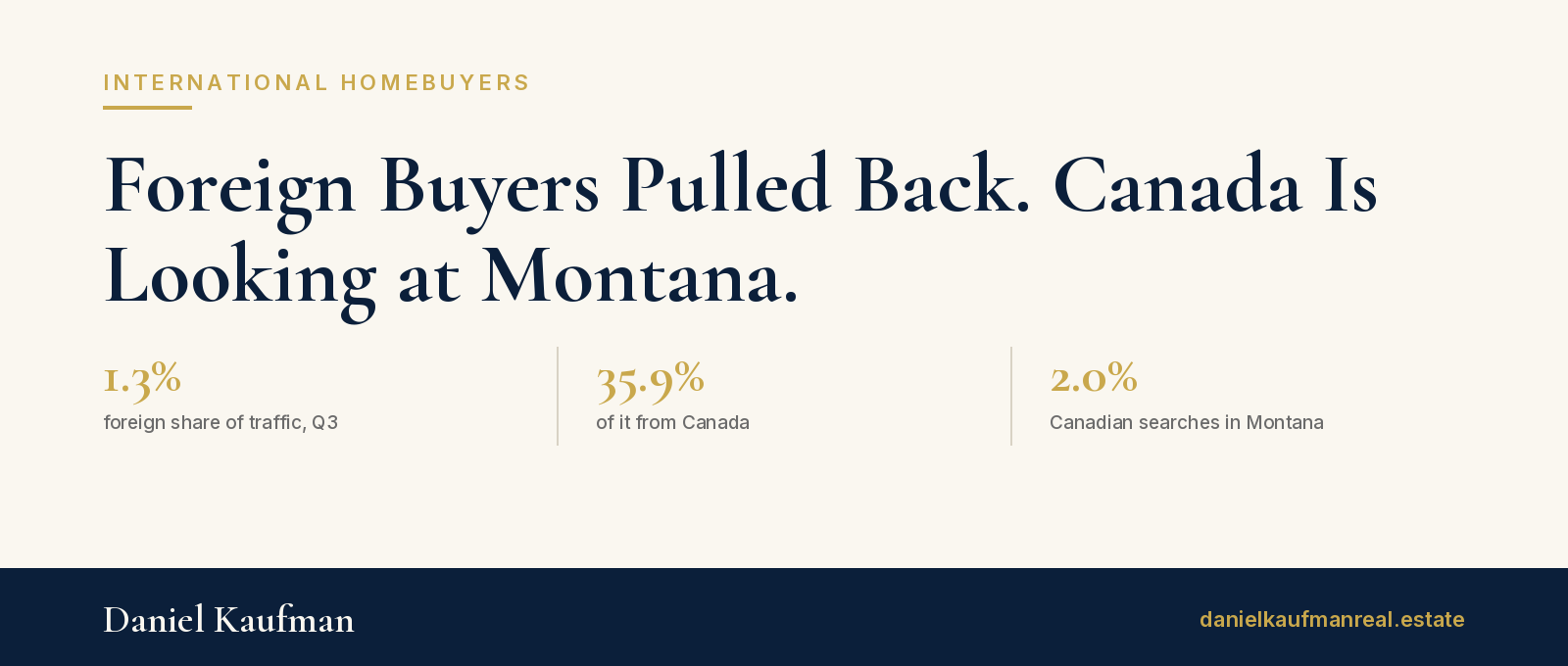

International demand for U.S. homes cooled again this fall, but the details matter more than the headline. Realtor.com’s quarterly International Demand report, released today, shows foreign shoppers made up 1.3% of traffic on the site from July through September, down from 1.5% a year ago. Europeans drove the drop, falling to 24.5% of international demand, the lowest share since 2019, with U.K. and German interest at seven year lows for the quarter.
What happened
Canada went the other way. Canadian shoppers rose to 35.9% of international traffic, up from 32.3% a year earlier, according to the report. Florida still draws nearly 29% of Canadian searches, and Texas edged past California for second place, 8.8% to 8.6%. Realtor.com also pointed to NAR’s latest annual count, which found international buyers purchased 14% fewer U.S. homes than the year before, with Canadians accounting for 16% of international transactions.
The line I keep coming back to is not about Florida. It is about Montana. The state drew 2% of Canadian search demand this quarter, up from 1.3% in 2019, and its share of European traffic nearly doubled over the same span, to 0.9% from 0.5%. Brokers quoted by Realtor.com described buyers relocating to Bozeman for work and choosing single family homes close to town and recreation.
Where we see opportunity
That Montana signal matters for mountain and gateway towns. These are not only vacation buyers. A growing slice are households moving for jobs who need year round housing, schools and a reasonable commute, the same things the local workforce needs. In towns where land and entitlement are already the bottleneck, every newcomer competes for the same thin inventory, and the teacher, the nurse and the lift mechanic get pushed further down the valley.
The opportunity is on the supply side. Attainable, employer anchored housing on entitled land in gateway towns now has demand from two directions, locals who cannot find a place and newcomers who are bidding up what exists. Whoever controls buildable land close to those job centers holds the scarcest piece of the puzzle.
In Florida, the Canadian concentration is striking. Cape Coral drew roughly 66% of its international traffic from Canada, Naples 65.4% and North Port 61.4%, with Phoenix at 62.6%. Those markets have been hit by condo costs and insurance, so a steady northern buyer base is a real floor under parts of them.
Where we see the downfalls
That same concentration is the risk. When two thirds of a metro’s foreign demand comes from one country, it rides on one exchange rate and one trade relationship. Realtor.com’s sources pointed to tariffs, high prices and a weak Canadian dollar keeping many buyers on the sidelines, and Canadian interest dipped sharply in 2025 when trade tensions flared. A seller pricing a Cape Coral or Phoenix home off last winter’s snowbird season is assuming that relationship stays calm.
Search traffic is also not closing volume. Clicks are cheap, and NAR’s 14% drop in actual purchases is the better read on what international buyers did. For the Sun Belt, this lands on top of the Southern Squeeze: insurance, taxes and higher rates eroding the affordability that drew people south in the first place. Foreign demand will not rescue a market whose carrying costs no longer work.
What we are watching
Three things. Whether the Canadian share holds once winter stays are booked. Whether Montana’s gain shows up in sales and permits, not just searches, especially around Bozeman. And whether European demand keeps sliding along with travel to the U.S., which would hit New York and Texas, the two places where Europeans actually grew their share.
If you follow mountain and gateway towns, our free Mountain Watch tracks housing pressure, resort economics and the signals that move those markets, at https://www.landbriefing.com/mountain-watch.
From the newsroom: our new Deal Desk tool runs every submitted site through the same underwriting model our own team uses and returns a read in minutes, Kaufman & Company Launches Deal Desk, a Tool That Runs Every Site Through Its Own Underwriting Model.
About the Author
I’m the founder and CEO of Kaufman & Company, a permanent capital holding company that buys land and existing assets across multifamily, hotels, resorts, industrial, commercial, mixed use, AI infrastructure and data centers, and builds and holds them for the long term. My focus is workforce housing and employer-anchored development, including mountain resort communities.
Reach me at Daniel@kaufmanredev.com or find more at danielkaufmanre.com.
Sources
Foreign Buyers Pull Back From U.S., but Canadian Snowbirds Widen Their Lead, Realtor.com, November 25, 2026, https://www.realtor.com/news/trends/canadian-snowbirds-widen-lead-international-demand-report-november-2026/
Leave a Reply