
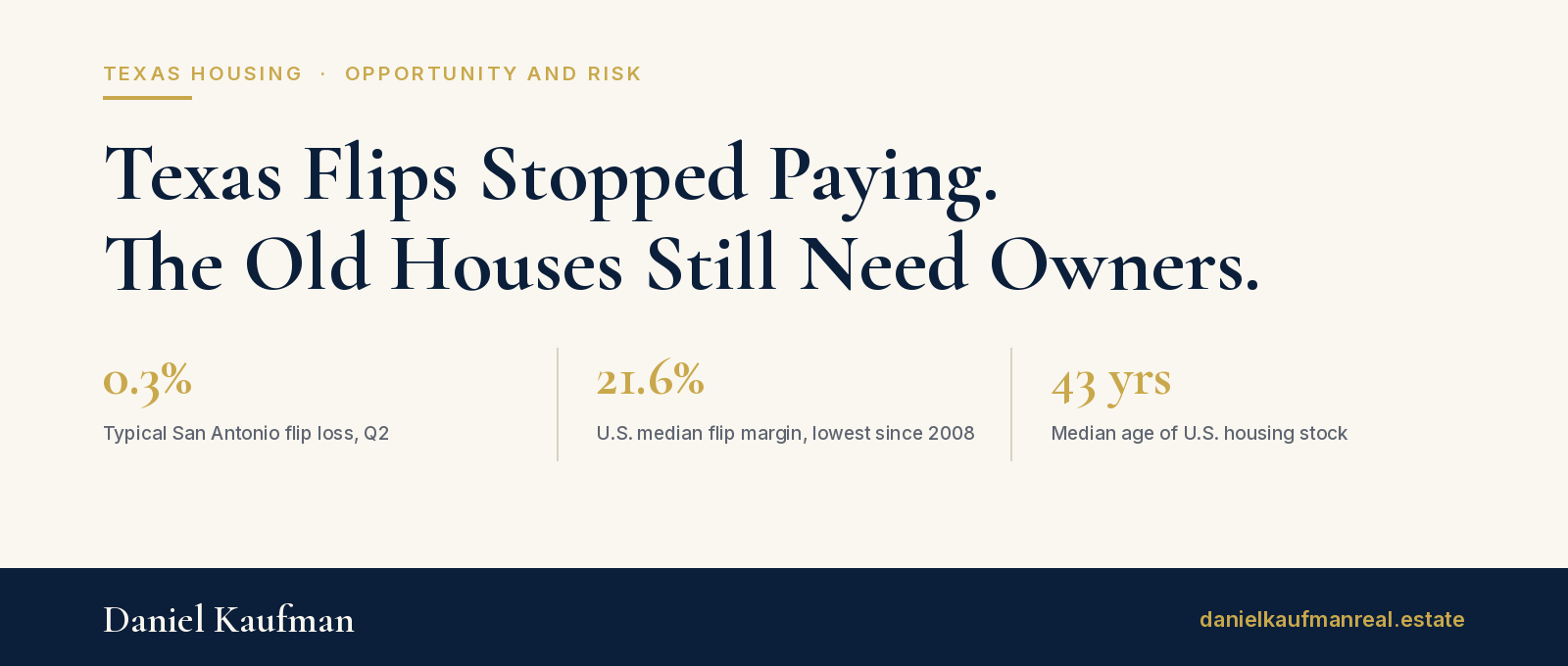

CRE Daily reported on Monday that four of the five least profitable metros in the country for flipping houses are now in Texas. Citing a Wall Street Journal analysis of ATTOM data, it ranked San Antonio dead last, where the typical second quarter flip lost 0.3%, with Dallas, Austin and Houston right behind it and Salt Lake City the only market outside Texas in the bottom five. Nationally, the median flipping margin slipped to 21.6%, the weakest reading since the 2007 to 2008 housing bust.
Those numbers flatter the trade. As CRE Daily pointed out, ATTOM compares only purchase and sale prices. Rehab and carrying costs, which veteran flippers put at 20% to 33% of after repair value, are left out, and flips that take more than a year to sell are not counted at all. A gross spread in the low 20s that has to absorb a cost load that large is not a margin. In San Antonio it is a loss before the first contractor shows up.
What happened
The causes are the ones we have been tracking all year: higher mortgage rates, steep property taxes and a glut of Covid era construction, according to CRE Daily. The same oversupply that softened Texas rents is now softening resale values. A flip is a bet that the next buyer will pay more, and in Texas the next buyer has more choices than at any point this cycle.
Meanwhile, the builders who delivered that supply are looking for work. Realtor.com reported this week that smaller builders across the country are pivoting to remodeling and repair as builder sentiment sits at a 14 year low. One coastal custom builder that delivers homes priced over $1 million is now replacing decks for $25,000. Realtor.com also noted, citing the Census Bureau, that the median age of the U.S. housing stock reached 43 years in 2025, up from 35 in 2010.
Where we see opportunity
The flip is broken. The house is not. An aging housing stock still needs roofs, plumbing and accessibility work, and someone has to own it through that work. That is a long term owner’s game, not a trader’s.
In Texas, I think the opening is older single family homes and small multifamily bought from sellers who planned to resell quickly and now cannot. Renovated to a durable rental standard and held, those homes become workforce housing in metros where new construction has stalled. The basis has to work on today’s rent, not the 2022 rent. CRE Daily’s Texas chart of the week put San Antonio apartment rents near $1.40 per square foot and declining, so the purchase price has to carry the whole cushion.
Contractors with real remodeling capacity also have a steadier book than new construction offers right now. Owners are staying put to protect low mortgage rates, and Realtor.com, citing the Harvard Joint Center for Housing Studies, reported that the do it yourself share of home improvement spending fell to a record low of 16% in 2023. With builders chasing that work, I expect renovation crews to be easier to schedule over the next year than they were during the boom, which lowers execution risk for anyone holding older stock.
Where we see the downfalls
Property taxes do not only hit flippers. A hold strategy in Texas has to underwrite taxes and insurance at today’s levels, and CRE Daily’s Texas newsletter has flagged soaring insurance premiums squeezing older Houston apartments. Older assets carry that risk first.
Old houses hide their costs. Realtor.com described remodelers opening floors to find rot and planning additions on foundations that turned out to have no footings. Renovation budgets need real contingency, and the inspection has to happen before the price is set, not after.
The remodeling pivot is a refuge, not a boom. Harvard’s Joint Center expects remodeling spending to stay subdued through next year, according to Realtor.com, so the builders crowding into repair work will compete hard on price. And forced selling by stuck flippers can push Texas resale prices lower before they stabilize. Buying early into a falling market is how patient capital becomes trapped capital.
What we are watching
Three things. First, whether ATTOM’s next quarterly read shows San Antonio’s losses spreading across more Texas metros or leveling off. Second, how many failed flips convert to rentals, which adds shadow supply and puts more pressure on rents. Third, 2027 tax appraisals and insurance renewals, which will decide whether older Texas housing pencils as a long hold at all. This is the K shaped housing economy at small scale: the luxury builder doing deck jobs and the flipper selling at a loss are on the same downswing, while the owner who buys at the right basis and holds is on the other leg.
If you own older housing stock in Texas or are weighing a site where the renovation math is uncertain, our Site and Feasibility Review at Kaufman Real Estate & Consulting is built to test the basis, the scope and the hold before you commit. You can find it at kaufmanrealestateandconsulting.com.
From the newsroom: land sellers and brokers can now run a site through the same underwriting model Kaufman & Company uses before any conversation starts, Kaufman & Company Launches Deal Desk, a Tool That Runs Every Site Through Its Own Underwriting Model.
About the Author
I’m the founder and CEO of Kaufman & Company, a permanent capital holding company that buys land and existing assets across multifamily, hotels, resorts, industrial, commercial, mixed use, AI infrastructure and data centers, and builds and holds them for the long term. My focus is workforce housing and employer-anchored development, including mountain resort communities.
Reach me at Daniel@kaufmanredev.com or find more at danielkaufmanre.com.
Sources
Texas Metros Dominate the List of Worst U.S. Cities for Home Flipping, CRE Daily Texas, November 23, 2026, https://www.credaily.com/newsletters/texas/issue/texas-metros-dominate-the-list-of-worst-u-s-cities-for-home-flipping/
Battered Home Builders Turn to Remodeling and Repair Work to Pay the Bills, Realtor.com, November 23, 2026, https://www.realtor.com/news/trends/battered-home-builders-turn-to-remodeling-and-repair-work-to-pay-the-bills/
Dallas Floats Its First Zoning Rewrite in 40 Years, Betting on Smaller Lots, CRE Daily Texas, November 16, 2026, https://www.credaily.com/newsletters/texas/issue/dallas-floats-its-first-zoning-rewrite-in-40-years-betting-on-smaller-lots/
Leave a Reply