
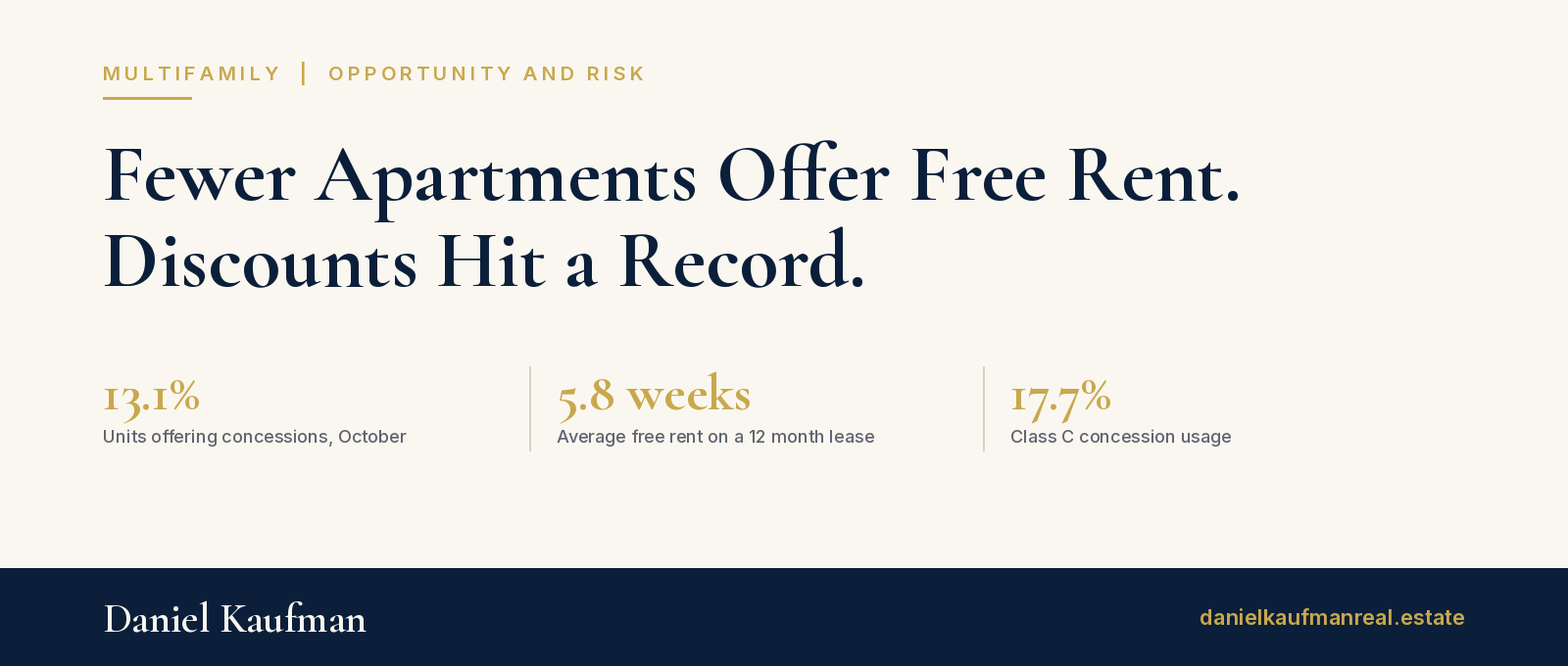

CRE Daily, citing RealPage Market Analytics, reported that concessions covered 13.1% of stabilized U.S. apartment units in October. That is down 1.4 points from September, the lowest share since June 2025 and the fifth straight monthly decline. Usage normally rises from September to October, and it did in 15 of the last 16 years, so this drop ran against the season.
Here is the catch. The average concession grew to 11.2% of the lease, roughly 5.8 free weeks on a 12 month lease and the deepest in records that start in 2010. Fewer buildings are discounting, but the ones that still need to are giving away more than at any point since the financial crisis.
What happened
Operators are cutting how many units carry an incentive before they cut the size of the incentive. Class A usage fell to 11% and Class B to 11.3%, while Class C barely moved at 17.7%. Class C depth rose to 11.5%, the most since March 2010. Back then, about half of stabilized units carried a concession. Today it is about a quarter of that reach at a similar depth.
The wider backdrop supports the read that the top of the market is firming. CRE Daily also reported that apartment occupancy reached 95.7% in the third quarter while the construction pipeline shrank about 6% to roughly 504,000 units, and Chandan Economics put national rents 2.7% above a year earlier as of October.
Where we see opportunity
The opportunity sits where the supply wave is finishing and occupancy is already tight. Newer Class A and B buildings in markets where deliveries are rolling off can now trade incentives for occupancy and start pushing net effective rent. A buyer underwriting those assets today can reasonably expect concessions to keep shrinking as the pipeline drains.
The more interesting opportunity is in Class C, because that is where the stress is pooling. Older buildings serving workforce renters are still discounting heavily, and CRE Daily reported that fresh appraisals on 295 distressed apartment loans cut values 33%, with 57% now worth less than what is owed. Owners who bought on 2021 and 2022 assumptions are running out of room. A long term owner with patient capital and real operating ability can buy that product at a reset basis, fix the deferred maintenance, and hold housing that working families can afford. That is the kind of workforce housing math that only works when you are not forced to sell in five years.
Where we see the downfalls
Record depth means asking rents overstate what buildings are actually collecting. Anyone underwriting off listed rent instead of trailing net effective rent is buying a number that does not exist. CRE Daily pointed to a 2025 Frisco property advertising 10 weeks of free rent while its owner faces a foreclosure sale in December. That is what lease up looks like when the debt was sized for a market that never arrived.
Class C is also where the tenant is most exposed. A renter in an older building has the least cushion against utility costs, insurance pass throughs and slower hiring. If the job market softens, that segment softens first, and a deep concession can turn into a vacancy instead.
And supply is not finished for good. CRE Daily reported apartment starts jumped 25.5% in October to a 433,000 annual rate. One month is not a trend, but if starts keep climbing, the relief owners are counting on could be shorter than the current numbers suggest.
What we are watching
Winter is the real test. Concession usage typically climbs from October through February, so if the share keeps falling through the off season, operators have more pricing power than the seasonal pattern implies. We are also watching the gap between Class A and Class C usage, now 6.7 points. If it widens, the apartment market is splitting along the same K shaped line as the rest of housing, with the top recovering and the workforce end carrying the strain.
If you are looking at an older apartment building or a site where the rent assumptions need a second look, a Site and Feasibility Review from Kaufman Real Estate & Consulting is a practical place to start. Details are at https://www.kaufmanrealestateandconsulting.com.
From the newsroom: Kaufman & Company launched Deal Desk, which runs any submitted site through our own underwriting model so land sellers and brokers get a first answer in minutes, Kaufman & Company Launches Deal Desk, a Tool That Runs Every Site Through Its Own Underwriting Model.
About the Author
I’m the founder and CEO of Kaufman & Company, a permanent capital holding company that buys land and existing assets across multifamily, hotels, resorts, industrial, commercial, mixed use, AI infrastructure and data centers, and builds and holds them for the long term. My focus is workforce housing and employer-anchored development, including mountain resort communities.
Reach me at Daniel@kaufmanredev.com or find more at danielkaufmanre.com.
Sources
Apartment Concessions Fall to 13.1% as Discounts Deepen, CRE Daily, November 20, 2026, https://www.credaily.com/briefs/apartment-concessions-fall-to-13-1-as-discounts-deepen/
CRE Sales Plunge 51% in October After Strong Q3 Rally, CRE Daily, November 20, 2026, https://www.credaily.com/newsletters/national/issue/cre-sales-plunge-51-in-october-after-strong-q3-rally/
Leave a Reply