

New York City has a housing plan and no storage plan. CRE Daily, summarizing reporting from GlobeSt, laid out why self storage developers are struggling to build in the five boroughs, and the details say a lot about how zoning, land and the cost of money decide what actually gets built in a dense city.
What happened
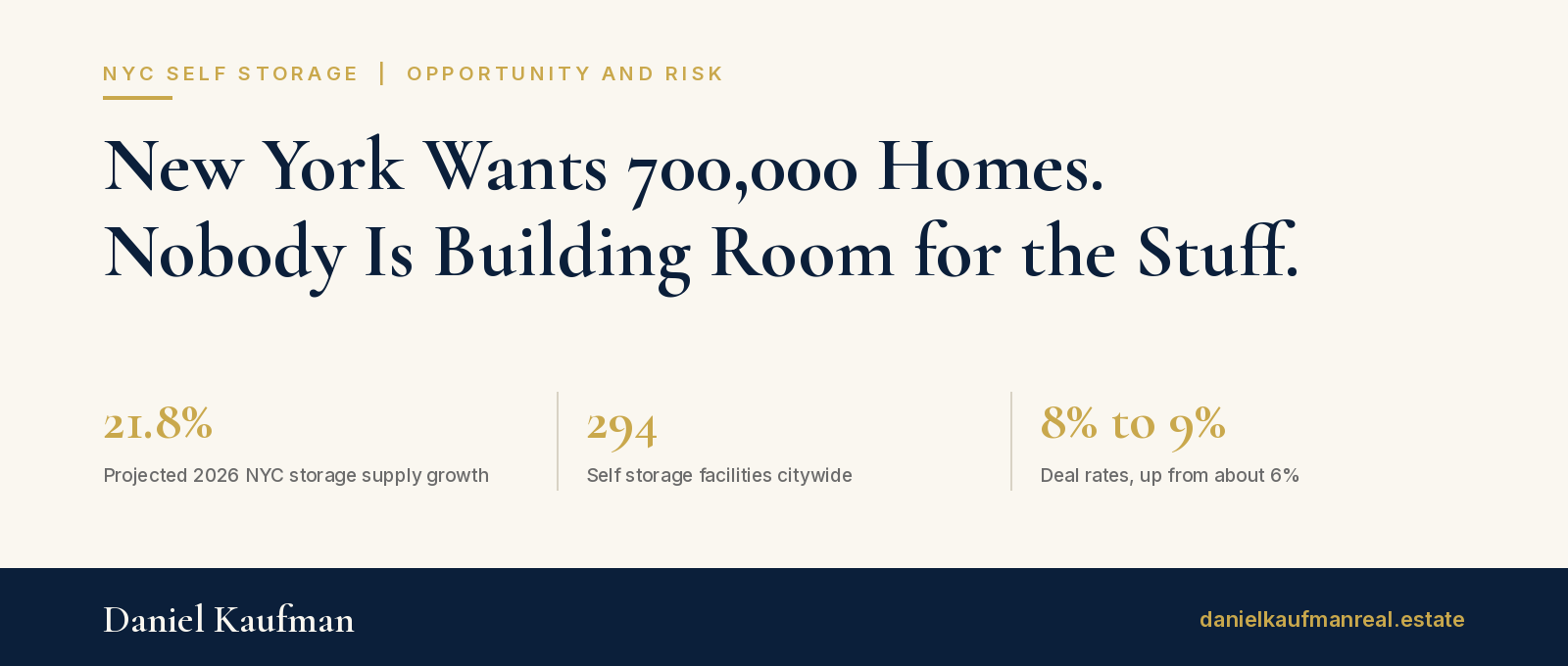
StorageCafe projects New York City’s self storage supply will grow 21.8% in 2026, according to CRE Daily. That sounds like a wave. A local developer told GlobeSt it is mostly delayed projects finally opening, with little new development behind them. The whole city has just 294 facilities and about 24.6 million square feet, per StorageCafe.
The economics turned quickly. The same developer said rates on storage deals moved from roughly 6% to a range of 8% to 9% while transactions were still being negotiated, as Treasury yields jumped. Lenders are underwriting cautiously after lease ups that disappointed them. Add safety requirements, a heavy volume of violations, dense streets and restrictive industrial and commercial zoning, and his firm could not find a workable site within a two hour radius of the city. It bought its first property in Elizabeth, New Jersey instead.
Where we see opportunity
Scarcity is the business plan for anyone who already owns. With almost nothing in the pipeline beyond what is opening now, the existing 294 facilities sit in a market where supply cannot respond quickly. The operating data backs that up. CRE Daily, citing Inside Self-Storage, reported third quarter same store NOI up 4.6% at Extra Space and 2.1% at CubeSmart.
The demand side is structural. The city is chasing about 700,000 new homes over ten years, and more than two-thirds of residents were renters as of 2021, according to the New York City Comptroller as cited by CRE Daily. Renters in a dense city often lack space. Every small apartment built without real closets is a future storage customer.
That points to two places I would look. First, existing buildings that already carry the right zoning, older industrial and commercial properties in the outer boroughs where the entitlement is the asset, not the structure. Second, the edges. The Elizabeth purchase is a tell. When the core is closed, demand spills into New Jersey, Westchester and Long Island sites with highway access, and land there gets repriced by what the city cannot accommodate.
There is also a lesson for housing developers. In dense workforce housing, storage is an amenity residents will pay for. Building it into the cellar or ground floor of a new residential project can turn hard to lease space into income and make small units more livable. That decision belongs at the site planning stage, because adding it later rarely works.
Where we see the downfalls
Supply constrained does not mean risk free. That 21.8% is real square footage that has to lease up in 2026, and lenders are already disappointed with how fast recent projects filled. If those deliveries cluster in a few neighborhoods, local rents can soften even while the citywide story stays tight.
The capital math is the bigger issue. A project that worked with 6% money does not work at 8% to 9% unless rents rise or land prices fall to absorb the difference. The developer also noted that in smaller towns, new supply can force price cuts quickly. That is a warning for anyone chasing the suburban spillover. The edge has less protection than the core.
Policy is the third risk. Developers want a tax abatement for self storage, and the developer quoted does not expect one under Mayor Zohran Mamdani’s housing focused administration. I would not count on one either. Any plan that needs a subsidy to work in New York is a bet on politics, not on demand.
What we are watching
Lease up speed at the 2026 deliveries, which will show whether the projected supply gets absorbed or lingers. Treasury yields, since the rate move is what broke deal math this fall. Any rezoning of the city’s industrial areas that opens or closes sites for storage. And land pricing in northern New Jersey, where storage, logistics and housing are competing for the same scarce parcels.
The headline says supply is growing. The ground truth is that New York has made storage nearly impossible to build, and the people who own it today hold a scarce asset because of it.
If you control a site in a dense market and are weighing what it can realistically support, whether storage, housing or a mix of the two, a Site and Feasibility Review through Kaufman Real Estate & Consulting can test the zoning, cost and demand before you commit. Learn more at https://www.kaufmanrealestateandconsulting.com.
About the Author
I’m the founder and CEO of Kaufman & Company, a permanent capital holding company that buys land and existing assets across multifamily, hotels, resorts, industrial, commercial, mixed use, AI infrastructure and data centers, and builds and holds them for the long term. My focus is workforce housing and employer-anchored development, including mountain resort communities.
Reach me at Daniel@kaufmanredev.com or find more at danielkaufmanre.com.
Sources
NYC Self Storage Developers Face Cost and Zoning Barriers, CRE Daily, November 9, 2026, https://www.credaily.com/briefs/nyc-self-storage-developers-face-cost-and-zoning-barriers/
Leave a Reply