
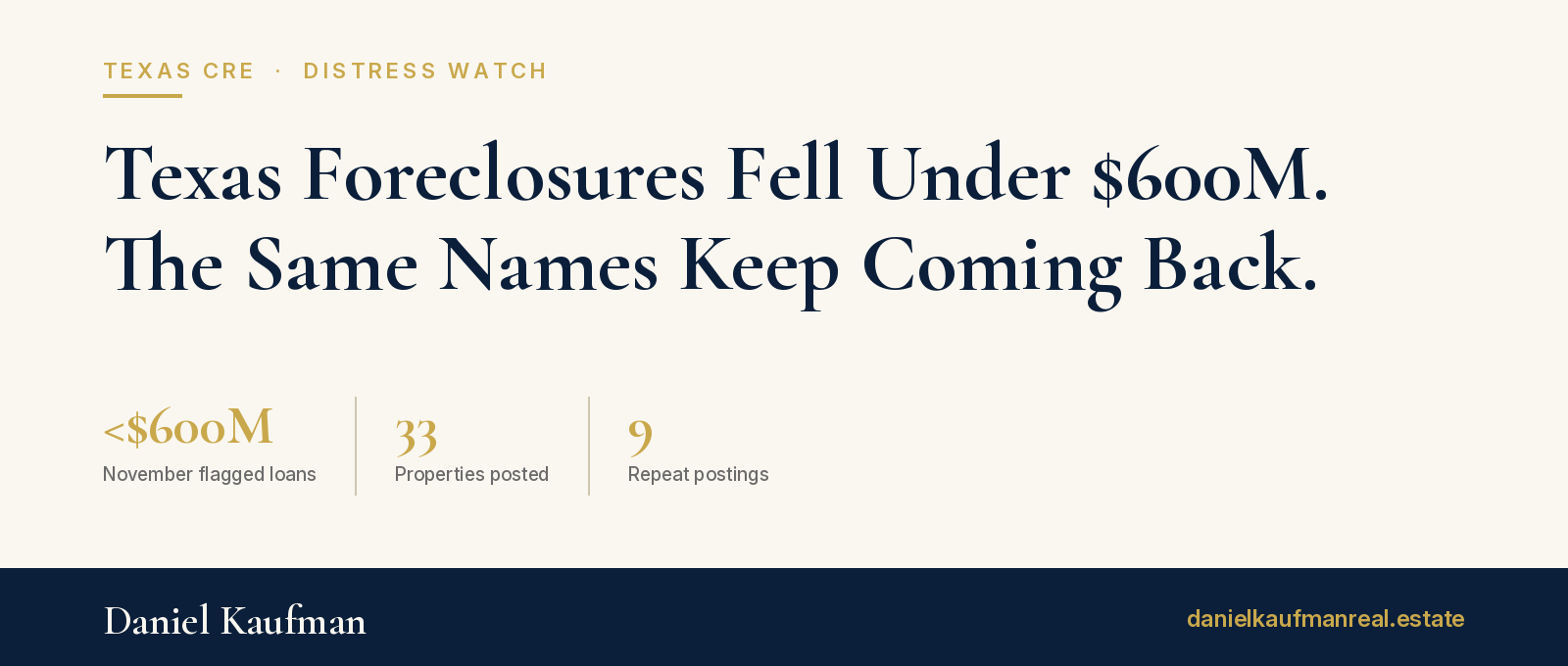

Texas just had a quieter month on the courthouse steps, and I would not read too much into it. CRE Daily reported that flagged troubled commercial loans for November auctions fell below $600 million, down from more than $1 billion in October, according to Roddy’s Foreclosure Listing Service data first reported by The Real Deal. Thirty-three properties are posted. Nine of them are loans that were already posted in earlier months.
What happened
Houston carries the heaviest load. Harris County accounts for 13 of the 33 flagged properties, the most of any county, per CRE Daily. The largest new name is a $56.7 million Goldman Sachs loan on the Offices at Pin Oak Park, a five-building, 505,000 square foot medical office complex built in 1975, which alone makes up about 10 percent of the month’s total. Its 2018 loan works out to about $112 per square foot.
Apartments fill most of the rest of the list, and the vintage is the tell. CRE Daily highlighted 2022 loans on Velo Flats in Austin and 500 Flats in Fort Worth, and pointed back to Trepp data showing that 2021 and 2022 loans accounted for 87.5 percent of the delinquent floating-rate apartment balance in Texas. CRE Daily also noted that Texas has now crossed the $1 billion line four times this year.
Where we see opportunity
The apartment side of this list is mostly good buildings with broken capital stacks. A 2022 property was financed at peak values on floating debt, and the physical asset did nothing wrong. When those loans finally resolve, someone gets to own a modern building at a basis that reflects today’s rates instead of 2022’s optimism. Some quick math on the reported loan balances: about $161,000 per unit at Velo Flats and about $103,000 per unit at 500 Flats. For a long-term owner who does not need to sell, those are the kinds of numbers worth underwriting carefully.
The broader Texas backdrop is also less grim than the foreclosure headlines suggest. In the same CRE Daily Texas issue, Dallas Fort Worth office vacancy fell 360 basis points year over year to 18.6 percent, and Houston retail held direct vacancy at 5.6 percent with record asking rents. Distress here is concentrated in specific vintages and specific buildings, not spread across the whole state.
Where we see the downfalls
First, the lower total is not resolution. Nine repeat postings tell you lenders and borrowers are still negotiating, and CRE Daily cautioned that repeat listings can reflect ongoing workouts or litigation. Some of this stress is being extended, not cleared.
Second, medical office is no longer a safe harbor. It was the property type everyone treated as recession proof. A 1975 complex at $112 per square foot may look cheap against replacement cost, but age, floor plates, and systems decide whether it is a bargain or a capital sink. A low basis does not fix obsolescence.
Third, the posted number overstates what will actually trade. Borrowers often settle before the sale date, so anyone hoping to buy straight off the auction list should expect most of the opportunities to disappear before the courthouse steps.
Finally, Texas capital markets carry fresh policy risk. CRE Daily reported that the governor-elect’s proposed data center moratorium has rattled lenders to the state’s AI buildout. Lender caution in one sector has a way of tightening credit in others.
What we are watching
I am watching how many of the 33 properties actually reach auction, and how many November loans roll forward again onto December’s list. I am watching whether 2021 and 2022 apartment loans keep dominating the postings, because that confirms this is a vintage problem rather than a demand problem. And I am watching Houston office, where older suburban and medical product will tell us whether basis alone is enough to bring buyers back.
Distress is a map, not a mood. The monthly list shows you exactly where the capital broke, and the job is to separate the buildings that are worth owning from the ones that are only cheap.
If you are evaluating a distressed Texas asset and want a clear read on basis, physical condition, and the path to stabilization before you commit, our Site and Feasibility Review at Kaufman Real Estate & Consulting is built for that: https://www.kaufmanrealestateandconsulting.com.
About the Author
I’m the founder and CEO of Kaufman & Company, a permanent capital holding company that buys land and existing assets across multifamily, hotels, resorts, industrial, commercial, mixed use, AI infrastructure and data centers, and builds and holds them for the long term. My focus is workforce housing and employer-anchored development, including mountain resort communities.
Reach me at Daniel@kaufmanredev.com or find more at danielkaufmanre.com.
Sources
Texas Foreclosure Volume Falls Below $600M in November, CRE Daily, November 6, 2026, https://www.credaily.com/briefs/texas-foreclosure-volume-falls-below-600m-in-november/
Texas Foreclosure Volume Drops Below $600M After October’s Billion Dollar Spike, CRE Daily Texas, November 9, 2026, https://www.credaily.com/newsletters/texas/issue/texas-foreclosure-volume-drops-below-600m-after-octobers-billion-dollar-spike/
Leave a Reply