

The comfortable story in apartments right now goes like this: the building wave is over, deliveries are falling, and owners get their pricing power back in 2027. I believe the supply half of that story. The demand half just got a lot less certain.
What happened
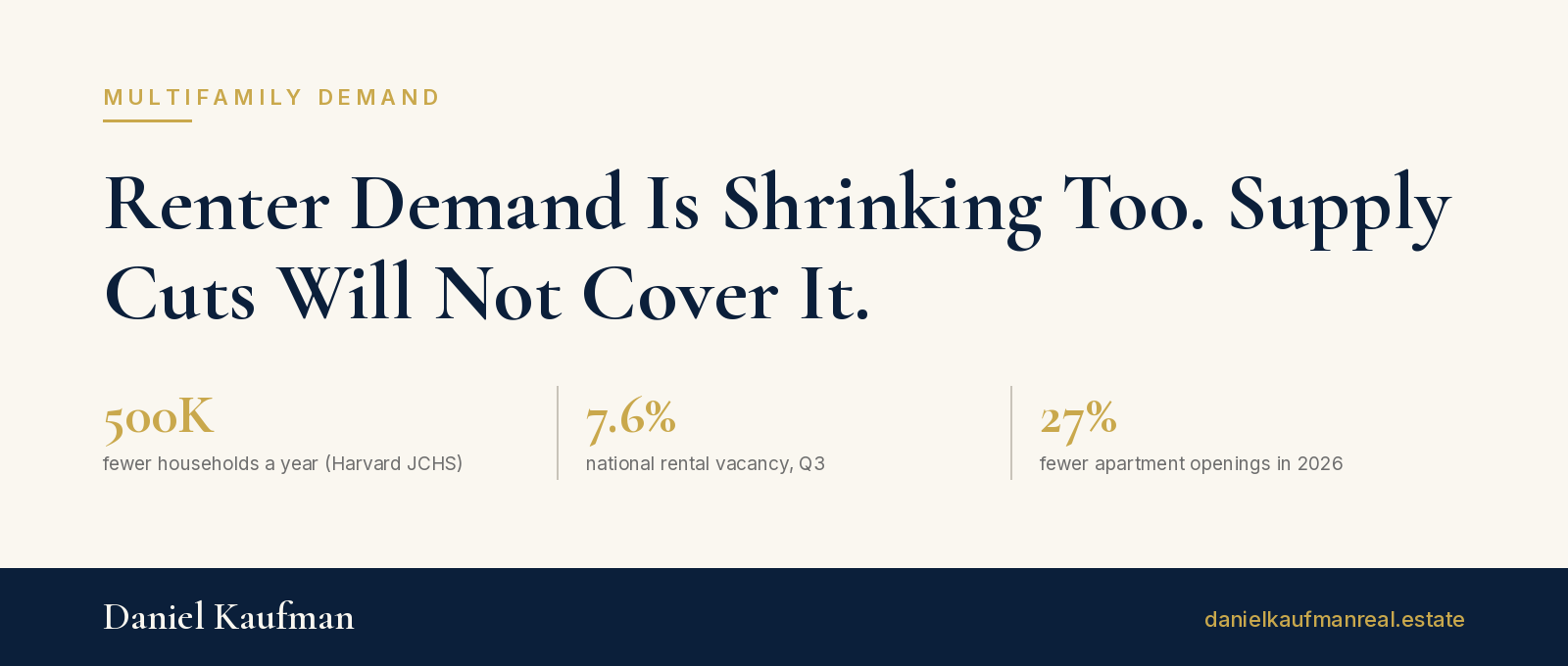
Realtor.com reported this week on new estimates from Harvard’s Joint Center for Housing Studies showing that tighter immigration policy means roughly 500,000 fewer households forming each year from 2024 to 2027, about 2 million in all, and most of them renters. Harvard researcher Daniel McCue drew the contrast clearly. Immigrants who arrived from 2022 to 2024 formed about 571,000 net new renter households, and he now projects immigrants will account for only about 132,000 new households by 2027.
The early evidence is already in the Census data. According to the same Realtor.com report, the national rental vacancy rate rose from 7.1% in the third quarter of 2025 to 7.6% in the third quarter of this year, alongside a slowdown in household formation overall.
Now put that next to the supply side. CRE Daily, citing RentCafe, reported that 442,395 apartments will open in 2026, down 27% from 605,768 last year and below the ten year norm. Dallas deliveries are down 45.1% and Austin’s are down 60.4%. RentCafe reads the drop as the end of a building cycle rather than weaker demand. That is the assumption I would stress test before I paid for it.
Where we see opportunity
Supply and demand are now falling at the same time, so the real question is which one falls faster in a given submarket. That is a local answer, not a national one.
The strongest position is demand anchored to a payroll. Renters tied to hospitals, school districts, utilities, public universities with mostly domestic enrollment, and manufacturing plants that hire locally are far less exposed to visa policy. That is the core of workforce housing and employer anchored development, and it is why we underwrite the jobs before we underwrite the rents.
The second opportunity is in the markets that cut their pipelines hardest. If job growth holds in Dallas and Austin, a 45% to 60% drop in deliveries should outrun the lost immigrant demand. Stabilized buildings bought below replacement cost, from owners who are tired of concessions, look better there than a new start does.
The third is land. A developer who controls entitled land without a forced start date can wait for the demand picture to clear instead of breaking ground into it. In this market, patience on dirt is worth more than speed on vertical.
Where we see the downfalls
Gateway and student heavy submarkets carry the most exposure. Workers and students on visas have been a major source of rental demand, and John Burns Research and Consulting told Realtor.com that visa uncertainty also makes those renters reluctant to buy. Class B and C buildings in immigrant gateway neighborhoods, and new product leasing up near universities with large international enrollment, are where a softer renter pool shows up first.
The riskiest asset in the market is a lease up underwritten on 2023 absorption. If the people who filled those buildings are no longer arriving at the same pace, the concession burn lasts longer than the pro forma allowed.
Debt makes it worse. CRE Daily’s chart of the day showed multifamily loans refinancing at 5.69%, up from 4.04%, a 41% jump in interest cost. An owner who needed rent growth to refinance now needs it against a smaller pool of new renters. Softer occupancy and a rate reset arriving together is how decent buildings become distressed loans.
There is also a second order effect. Realtor.com noted that homebuilders lean heavily on immigrant labor and that the crackdown has weighed on builder sentiment. Fewer workers means higher costs and a later start to the next building cycle. That supports owners of existing units over the long run, but it does nothing for the lease up that has to hit occupancy this spring.
What we are watching
First, the quarterly Census vacancy number. If vacancy keeps climbing while deliveries fall, the problem is demand, not supply, and the recovery thesis needs a new timeline.
Second, concessions in Dallas and Austin through the spring leasing season. Shrinking pipelines should show up as shrinking free rent. If it does not, lost renters are filling the gap.
Third, international enrollment and visa issuance near university submarkets, which will tell us where the demand loss is concentrated.
Data over emotion. The supply drop is real, and so is the demand drop. Underwrite both.
If you are weighing a lease up, an acquisition, or a new start in a market where this matters, a feasibility review that stress tests absorption against a smaller renter pool is cheap insurance. That is the work we do at Kaufman Real Estate & Consulting: https://www.kaufmanrealestateandconsulting.com
About the Author
I’m the founder and CEO of Kaufman & Company, a private investment and holding firm working across real estate development, venture investment, and infrastructure. My focus is workforce housing and employer-anchored development, including mountain resort communities through Oldivai.
Reach me at Daniel@kaufmanredev.com or find more at danielkaufmanre.com.
Sources
Immigration Slowdown To Sharply Reduce Renter Household Growth, Study Says, Realtor.com News, November 2, 2026, https://www.realtor.com/news/real-estate-news/immigration-slowdown-enter-household-growth-jchs/
Apartment Openings Fall 27% in 2026 as New York Metro Bucks the Slowdown, CRE Daily, November 3, 2026, https://www.credaily.com/newsletters/national/issue/apartment-openings-fall-27-in-2026-as-new-york-metro-bucks-the-slowdown/
Leave a Reply