
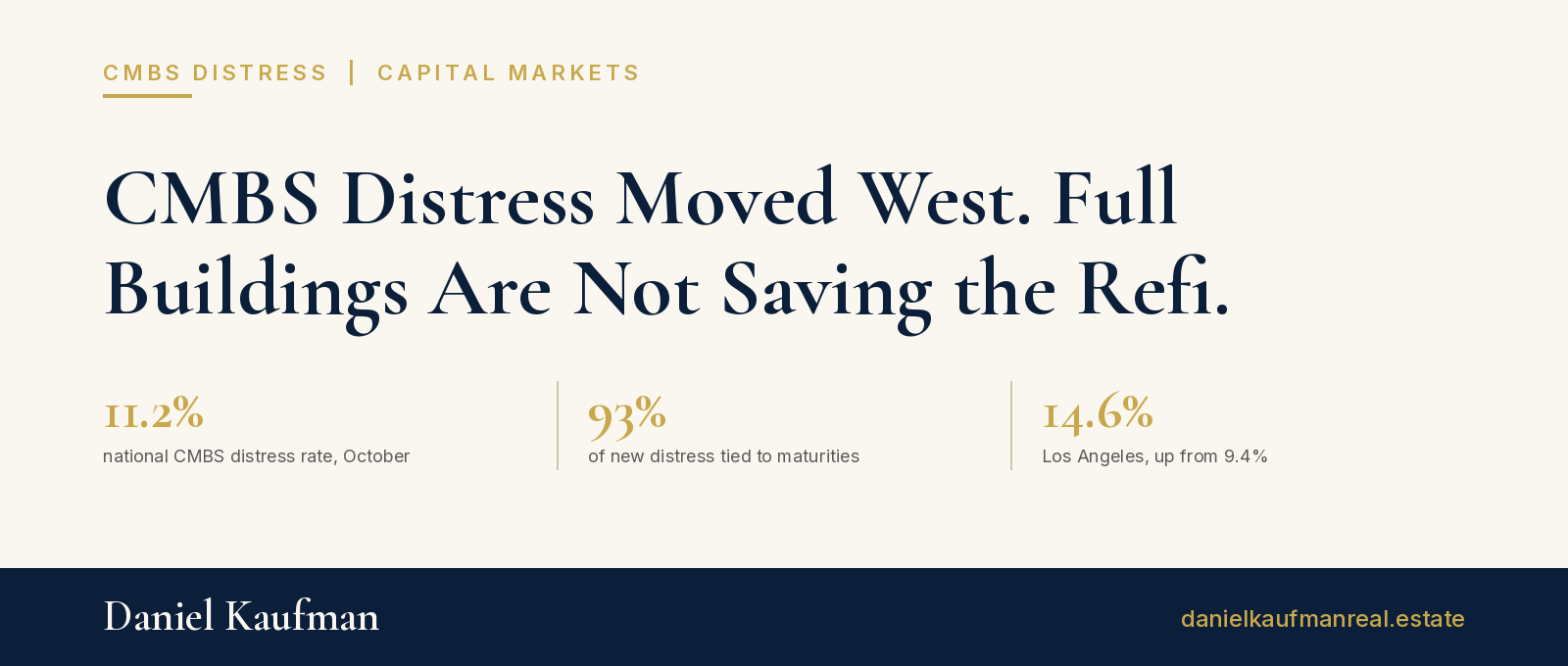

The commercial mortgage distress story has changed its address. CRE Daily, citing new CRED iQ data, reported that the national CMBS distress rate rose to 11.2% in October, up from 10.9% a year earlier, and that another $4.5 billion of debt became newly distressed during the month. The part I would underline is that 93% of that new distress was tied to loans at or nearing maturity. This is a refinancing problem first and a demand problem second.
What happened
New York, long the center of the conversation, actually improved to an 11.2% distress rate, according to CRE Daily. The pressure moved to Chicago, which led major metros at 23.5%, Philadelphia at 23.0%, Houston at 15.3%, and Los Angeles, which jumped from 9.4% to 14.6%. Office remains the heaviest weight at 16.4% distress nationally and 44% of all distressed CMBS debt, with office rates of 32.6% in Chicago, 31.5% in Houston, and 21.5% in Los Angeles.
The detail that should change how people underwrite: occupancy is no longer a shield. CRE Daily highlighted a Philadelphia office tower that is 99.5% occupied entering special servicing on a $205 million loan, and a California regional mall that is 97.6% occupied going delinquent on $325 million. When a full building cannot refinance, the issue is the gap between the old loan balance and what today’s value and today’s rates will support.
Where we see opportunity
Maturity driven distress produces sellers who have to transact, not sellers who want to. That is where disciplined buyers with real equity get pricing they cannot get in an orderly market. CRE Daily noted that Blackstone Mortgage Trust took a $327.6 million third quarter loss writing down pre 2023 office loans while its post 2023 book grew about 50% over the year. Lenders are cleaning up the old vintage and lending into the new one at reset values. That reset basis is the opportunity.
I would also look past office. CRE Daily reported that October’s newly distressed loans included $1.1 billion of hotel debt, $700 million of retail, and $500 million of industrial. Well located, well occupied assets that only need a capital structure fix are the cleanest workouts, because the operations are not the problem. Recapitalizations, note purchases, and rescue preferred equity will do more business over the next year than ground up starts.
Where we see the downfalls
The risk is assuming distress means bargains everywhere. Office in Chicago and Houston at roughly one in three loans distressed is a signal that values are still being discovered, and catching a falling basis is not the same as buying a reset one. The 10 year Treasury closed at 4.931% on October 30, per CRE Daily’s market snapshot, so the refinance math is not about to get easier on its own.
The other exposure is in the structures built during the cheapest money. CRE Daily reported that older CRE CLOs issued in 2021 and 2022 carry a 34.8% distress rate. Floating rate transitional debt on business plans that assumed rising rents and falling rates is where the next wave of extensions and modifications will come from, and lenders have less room to extend than they did a year ago.
What we are watching
First, whether distress keeps spreading to metros that were considered safe, the way Los Angeles moved in a single year. Second, how many of these maturities get extended versus resolved, because extensions delay price discovery. Third, whether hotel and retail distress stays a capital structure story or becomes an operating one. And fourth, how quickly the new lending book grows, because a functioning lender at reset values is what ultimately clears this cycle.
If you own or are evaluating an asset facing a maturity, a capital structure and feasibility review is the right first step, and that is the work we do at Kaufman Real Estate & Consulting, https://www.kaufmanrealestateandconsulting.com.
About the Author
I’m the founder and CEO of Kaufman & Company, a private investment and holding firm working across real estate development, venture investment, and infrastructure. My focus is workforce housing and employer-anchored development, including mountain resort communities through Oldivai.
Reach me at Daniel@kaufmanredev.com or find more at danielkaufmanre.com.
Sources
CMBS Distress Climbs to 11.2% as Strain Shifts From New York to L.A. and Chicago, CRE Daily, November 2, 2026, https://www.credaily.com/newsletters/national/issue/cmbs-distress-climbs-to-11-2-as-strain-shifts-from-new-york-to-l-a-and-chicago/
Leave a Reply