
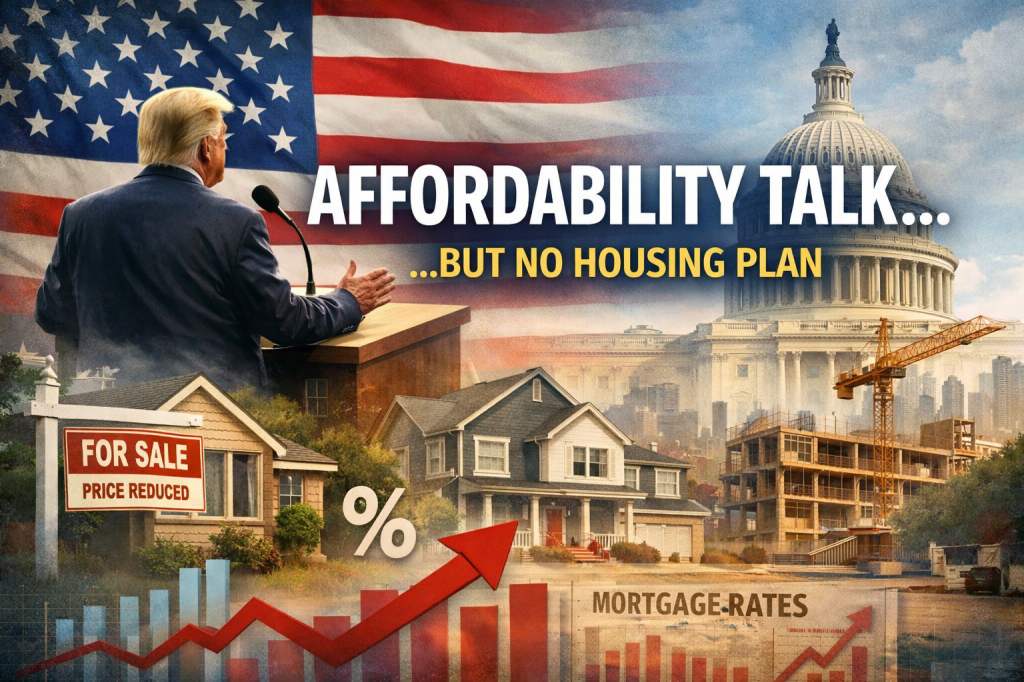
The market heard a message on inflation, taxes, and tariffs. What it didn’t hear was a clear housing roadmap.
President Trump’s State of the Union touched almost every major economic theme, inflation, tax policy, trade, jobs, and energy, but housing was mostly treated as a supporting character.
That matters.
Housing affordability is not a side issue right now. It is one of the central economic pressures shaping how people live, where they move, what they can buy, and whether they can build any real financial stability. So when the White House speaks at length about costs and only briefly about housing, the omission is not trivial, it is a signal.
From a real estate perspective, the speech was notable less for what it announced, and more for what it did not.
The headline message was affordability, but housing got very little detail
Trump framed the speech around costs, inflation relief, and economic momentum. Housing came up, but mostly in fragments, folded into broader economic claims rather than treated as a standalone policy area.
That is the key takeaway for anyone in real estate, construction, lending, or housing policy.
Yes, there were references to mortgage rates, homeownership, and institutional investors. Yes, the language around the “American dream” was politically effective. But if you were listening for a practical legislative or administrative roadmap on housing supply, financing, zoning, rental support, or first-time buyer relief, there was not much there.
In other words, there was rhetoric around affordability, but not much policy architecture.
The central tension remains unresolved
Trump repeated a politically popular goal, make housing more affordable without reducing home values.
That is the challenge every administration wants to solve. It is also where the real policy tradeoffs begin.
On paper, it sounds like a win-win. In practice, it is difficult to deliver at scale without increasing supply meaningfully, improving financing conditions, and reducing friction in the development pipeline.
If prices stay elevated to preserve household wealth, and rates remain structurally higher than the ultra-low era, affordability does not improve much for new buyers unless incomes rise faster or housing costs come down through increased inventory.
That is why the absence of a supply-focused strategy stood out.
There was no clear standalone discussion of how the administration plans to accelerate production, reduce permitting delays, reform local barriers, expand workforce capacity, or materially lower the cost basis of building new housing.
And that is where affordability is won or lost.
The institutional investor ban is politically potent, but economically limited on its own
One of the more direct housing points in the speech was Trump’s push to restrict institutional investors from buying single-family homes, and his call for Congress to make the ban permanent.
This is the kind of policy that resonates immediately with the public because it maps to a real frustration. Many buyers have experienced bidding wars where cash offers move faster than financed households can compete. That frustration is real, and policymakers ignore it at their own risk.
But the harder question is whether banning institutional purchases meaningfully changes affordability at the market level.
That depends on geography, concentration, enforcement, and what happens next.
In some neighborhoods, institutional activity can distort pricing and tighten supply for owner-occupants. In others, the effect is far smaller than the political attention suggests. A national ban may sound sweeping while producing very uneven local outcomes.
The bigger issue is that even if such a ban helps at the margin, it does not replace a supply strategy.
The U.S. is still dealing with a long-running structural housing shortage. Restricting one category of buyer may improve optics and possibly create localized relief, but it does not build new homes.
And right now, the country needs more homes.
Rates matter, but they are not the whole story
The speech leaned heavily on falling rates and lower payments as evidence that affordability is improving.
Rates absolutely matter. They affect purchasing power, underwriting, monthly payments, refinancings, construction starts, and investor sentiment. Every real estate operator watches them for a reason.
But affordability is not a single-variable equation.
Even if mortgage rates move in the right direction, buyers are still dealing with elevated home prices, insurance costs, taxes, utilities, and, in many markets, a lack of available inventory. Builders are still dealing with land costs, labor shortages, entitlement delays, and material pricing volatility.
So yes, lower rates help. They help a lot.
But lower rates without more supply can also re-ignite demand faster than inventory expands, which can keep price pressure in place.
That is why a speech that emphasizes rates but offers little clarity on supply policy leaves the industry in wait-and-see mode.
Tariffs and construction costs remain a major wildcard
Trump also doubled down on tariffs and signaled he intends to keep them in place through alternate legal pathways after court setbacks.
For housing and development, this is not abstract policy debate. It flows directly into project budgets.
Tariffs can affect building materials, equipment, and supply chains in ways that raise costs, delay schedules, and compress already-thin margins. Even when final impacts vary by product category, the uncertainty itself is costly. Developers can plan around high costs. It is harder to plan around moving targets.
That is the problem with tariff uncertainty in a housing affordability conversation.
If the administration’s affordability message is serious, it eventually has to reconcile the tension between pro-growth rhetoric and cost inputs that can make construction more expensive.
The construction industry understands this better than anyone because it lives inside that math every day.
The speech had economic energy, but not a housing framework
There was also a broader optimism in the address, jobs, new business formation, factories, labs, construction momentum, national strength. Politically, that is coherent. It is a growth narrative.
But housing policy still felt underdeveloped.
There was no clear federal housing construction strategy. No direct focus on zoning reform. No detailed mention of rental assistance, first-time buyer tax credits, or housing finance modernization. No serious outline for how Washington plans to address the mismatch between demand and supply in the short run, and how it intends to support durable production in the long run.
That does not mean housing is off the agenda.
It means housing is still being discussed as a symptom of inflation and cost pressure, rather than treated as a system with its own bottlenecks, timelines, and policy levers.
For people in the industry, that distinction is everything.
Why this matters in 2026
Housing affordability has now become one of those issues that everyone agrees is urgent, but fewer people are willing to address at the level of detail required to fix it.
That is not a partisan observation. It is just where we are.
The market does not respond to slogans. It responds to permits, financing, labor, infrastructure, policy certainty, and actual units delivered.
If Washington wants lasting affordability relief, it will need more than speeches about protecting home values and lowering rates. It will need a real strategy to expand supply, reduce production friction, and create conditions where builders can build at scale without taking outsized risk at every step of the process.
Until then, housing will continue to show up in national speeches as a political priority, while remaining operationally unresolved.
And for developers, lenders, brokers, contractors, and families trying to buy a home, that gap is the story.
 Daniel Kaufman Real Estate
Leave a comment