
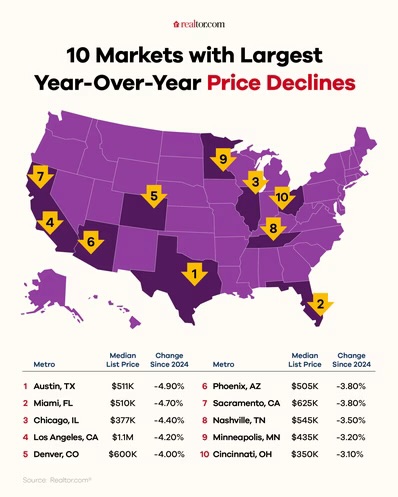
The headlines are starting to reflect what many of us in the business have been watching unfold for over a year now: home prices are dropping — and not just in one or two isolated markets. According to the latest data, 33 of the top U.S. metros have seen measurable declines since the peak in 2022. The usual suspects are leading the slide — pandemic boomtowns like Austin and Miami, where prices soared more than 50% in under two years.
Let’s talk about Austin.
Prices there are down nearly 15% from peak levels. Inventory is sitting, price cuts are widespread, and homes are now averaging over 65 days on market. This isn’t a crash — it’s a classic demand reset. What we’re seeing is the result of basic affordability math: 7%+ mortgage rates, elevated taxes, and higher insurance premiums have fundamentally changed the monthly payment equation.
The buyers who drove Austin’s boom weren’t just coming for job growth or lifestyle — they were coming for arbitrage. Now that arbitrage is gone, and the “need to sell” crowd is showing up. Sellers aren’t testing the market; they’re actively cutting to find the floor. And when rates finally break back toward 6%, you’ll see the market firm up again. Until then? It’s going to be choppy.
Now look east — to Miami.
Miami’s correction has been slower to grab headlines, but it’s happening. Median list prices are down nearly 18% from the 2022 peak. Condo fees, insurance costs, and a sharp drop in buying power have pushed many would-be buyers to the sidelines. The average Miami listing now sits for 88 days — a full month longer than the national average.
This isn’t just a pricing problem; it’s a buyer psychology problem. The same market that saw an inflow of luxury buyers, pandemic movers, and tax migrants is now wrestling with oversupply, fee fatigue, and buyer paralysis. Second-home owners are unloading. Out-of-state investors are looking elsewhere. And in the absence of urgency, even serious buyers are taking their time.
But here’s the key point I want to make — this isn’t a collapse. It’s a recalibration.
Austin and Miami are textbook examples of pandemic-era overheating. Both cities saw run-ups over 55% in home values during the COVID cycle. That kind of growth isn’t sustainable — not when rates double, and not when the fundamentals lag behind.
As developers and investors, we’ve seen this movie before. Booms like these always come with a cool-down. What matters now is who stays disciplined.
If you’re in acquisition mode, this is the window to underwrite with realism and patience. If you’re developing, build defensively. Know your absorption rates and your exit strategies. And if you’re holding assets, resist the temptation to chase comps from two years ago. That era is over.
Markets like Austin and Miami are still long-term winners — but in the short term, they’re resetting. Smart capital will wait for distress to become visible, and when it does, it’ll be ready to deploy. We’re not there yet — but we’re getting close.
If you’re an investor or operator looking to understand where this market is headed and how to position yourself, this is the time to lean in.
 Daniel Kaufman Real Estate
Leave a comment