
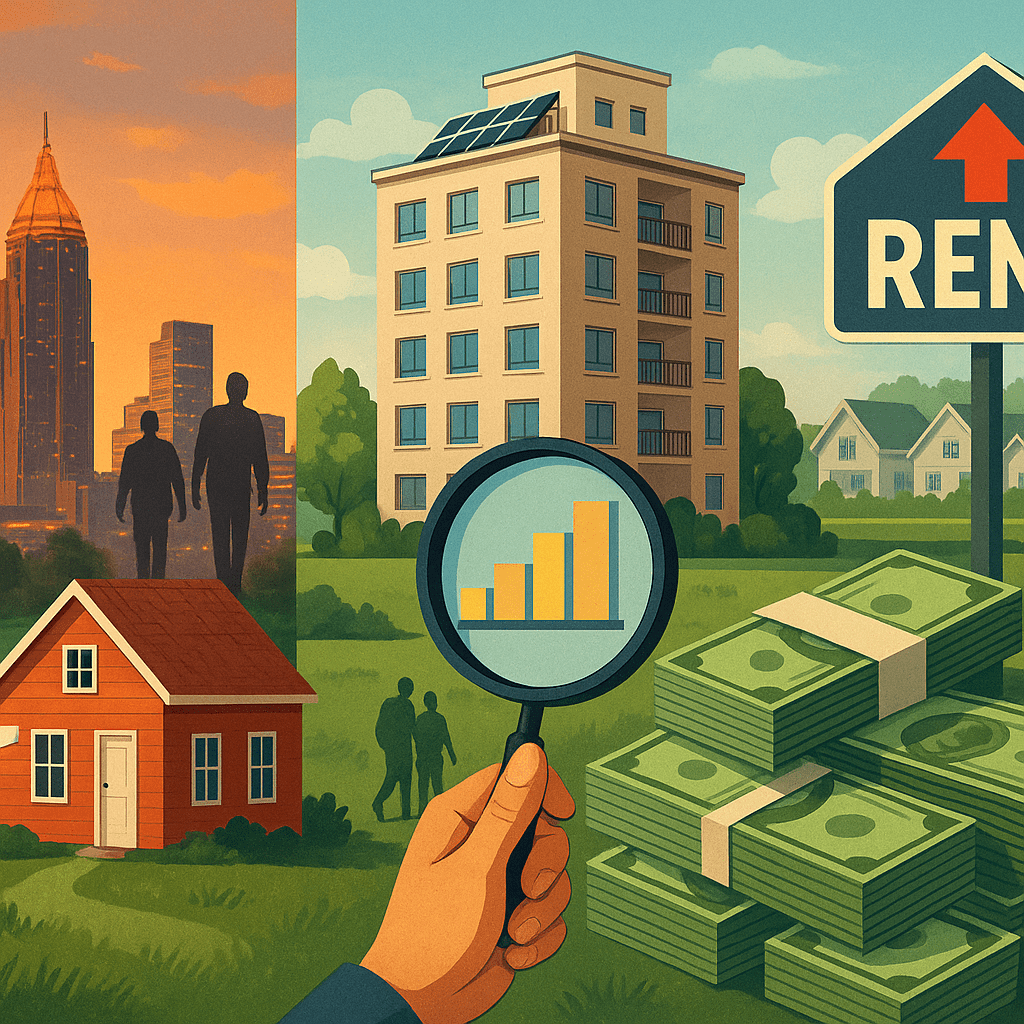
For decades, Atlanta was a growth story developers could count on. Affordable housing, job creation, and strong in-migration made it one of the Sun Belt’s marquee markets. But we’ve hit a turning point: between mid-2023 and mid-2024, metro Atlanta posted a net loss in domestic migration for the first time in over 30 years.
That’s not just a stat — it’s a signal. One that developers, investors, and urban planners alike need to pay close attention to.
Why Are People Leaving Atlanta?
The factors driving this shift are both predictable and deeply structural:
Affordability is eroding. Infrastructure is stretched thin. Housing development isn’t keeping up.
While apartment construction rebounded post-pandemic, single-family homebuilding slowed. From 2020 to 2023, Atlanta’s housing stock expanded just 0.6%. That’s a steep drop from previous decades, and it’s made worse by rising land constraints — including competition from data center expansion.
Traffic congestion and commute times are another key factor. Even wealthier residents are rethinking whether Atlanta’s quality of life justifies the price tag. And in the commercial sector, a quarter of office space in the metro sits vacant. Microsoft’s highly publicized Westside campus is now paused indefinitely. Luxury apartment vacancies are climbing too, a byproduct of that same migration slowdown.
Where Is the Growth Going?
Smaller Southern cities are picking up the slack — and fast. Places like Chattanooga, Knoxville, Huntsville, and Greenville are seeing growth metrics that beat their pre-pandemic averages. These metros offer what many larger Sun Belt cities no longer can: lower housing costs, better commutes, and livable scale. They’re also benefiting from the stickiness of remote work and the demand for hybrid-friendly lifestyles.
If you’re looking to place capital or entitle land, I’d be watching these markets very closely.
National Rent Trends: Two Sides of the Sunshine State
Zooming out, June marked a national milestone: for the first time since 2021, demand for apartments exceeded supply. But regional dynamics remain starkly uneven.
In Florida, a clear split has emerged:
Gulf Coast markets like Naples, Fort Myers, and Cape Coral are leading the nation in rent declines. Atlantic Coast cities including Hollywood, Fort Lauderdale, and West Palm Beach are showing solid rent growth.
This divergence is being driven by storm-related disruption on the Gulf side, higher insurance costs, and elevated new supply. Vacancy rates on the Gulf Coast are rising, while the Atlantic side is tightening — a reminder that local conditions still matter in a state that’s often discussed monolithically.
Nationwide, the average one-bedroom rent sits at $1,636/month (up 0.9% YoY) and two-bedrooms at $1,896. Vacancy held steady at 8.1%, but most forecasts expect it to fall to 7.5% in the coming months.
Multifamily Outlook: Past the Peak, But Not Out of the Woods
We’re past peak supply, but we’re not past the effects. The leasing environment remains competitive, with operators still offering concessions and pushing to stabilize a massive delivery wave. The first half of the year saw a lot of anxiety — not from lack of demand, but from mismatched expectations.
Too many owners assumed occupancy would rebound fast enough to erase concessions and push rents. That hasn’t materialized yet. The good news is that demand is not the problem — in fact, it’s strong. But supply is still being absorbed, and lease-ups take time.
What’s Performing?
Top rent growth markets: Brookline MA, Hollywood FL, Chicago, Brooklyn, and Columbus OH. Markets with the biggest drops: Cape Coral, Naples, Fort Myers, Sarasota, and Denver. Highest rents: New York ($4,022), Hoboken ($3,761), Boston ($3,530). Lowest rents: Oklahoma City ($903), West Virginia, and Arkansas.
The Midwest, Mid-Atlantic, and Northeast continue to outperform expectations. Even Silicon Valley is bouncing back as RTO (return to office) grows more common in tech. Meanwhile, the Sun Belt and Mountain West remain in digestion mode after record-breaking deliveries.
What’s Next?
If the macro picture holds — stable jobs, slightly lower rates — then the multifamily outlook remains positive, especially in high-demand, supply-constrained metros.
There’s also optimism around policy. We’re seeing:
Permanent renewal of the Opportunity Zone program. HUD streamlining approvals for affordable housing. California reducing CEQA abuse that stalls development. Texas unlocking commercial-zoned land for MF in urban cores.
As a developer, I’m optimistic. Not because the challenges are over — they’re not — but because the fundamentals of supply and demand still drive everything in this business. Demand never disappeared. It just had to wait for supply to catch up.
The back half of 2025 will be about absorption, stabilization, and seeing which markets are built for resilience — and which are still riding on legacy momentum.
If you’re placing capital, underwriting deals, or simply watching this sector — keep an eye on the fundamentals. They’re beginning to reassert themselves.
 Daniel Kaufman Real Estate
Leave a comment