
As real estate professionals, we’ve always known that architecture isn’t just about aesthetics—it’s about value, geography, and psychology. A home’s style tells a deeper story. It signals when and where it was built, who it was built for, and how it’s likely to perform in today’s market.
For our 2025 Architectural Style Report, we analyzed active single-family listings from Realtor.com to see how architectural styles stack up when it comes to price, square footage, appreciation, and location. While style definitions aren’t always consistent, a few clear patterns emerge—and they reveal a lot about where demand is heading.
🏡 What America Is Built On: Colonial and Ranch Still Reign
Colonial and traditional American homes dominate the landscape, making up nearly 50% of all for-sale listings in May 2025. Rooted in symmetry and simplicity, these homes evoke timeless Americana—and buyers continue to respond. Ranch-style homes follow close behind, representing about 34% of the national market.
But just because these styles are the most common doesn’t mean they’re all created equal. Ranch homes skew smaller and older, and they command a much lower median list price—around $369,000, compared to $459,000 nationally. Colonial homes, by contrast, are larger, newer, and appreciating at a faster clip.
📍 Where Styles Live: The Geography of Design
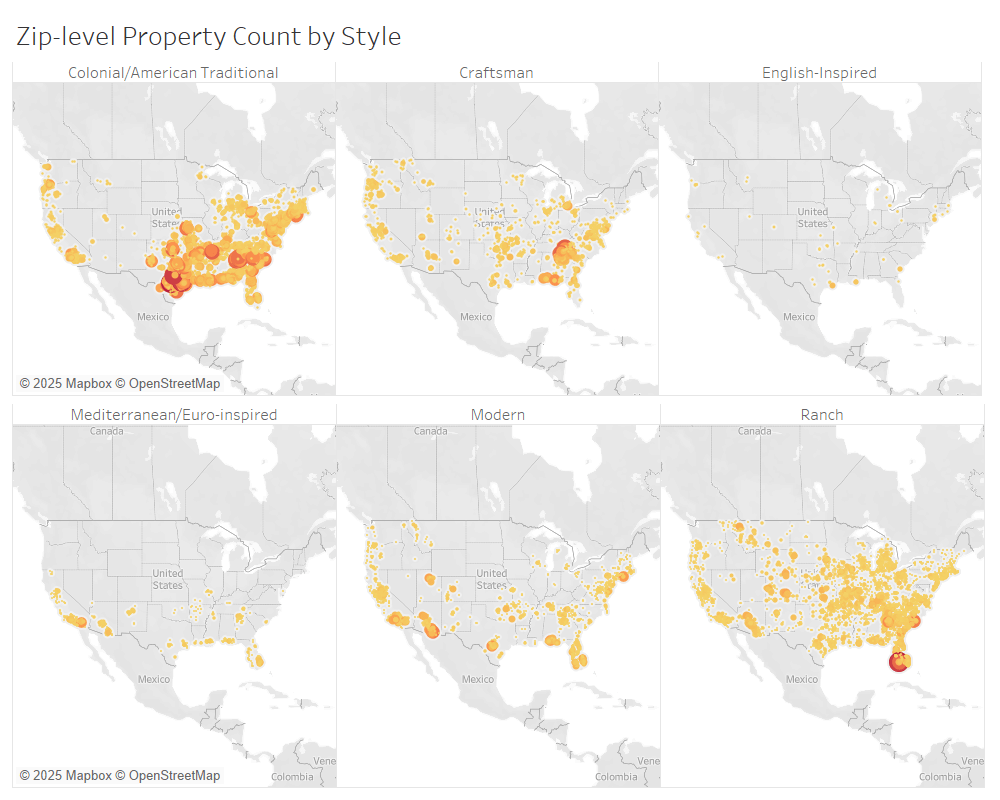
Real estate is local—and so is style.
Colonial/Traditional homes are concentrated in the South and Northeast, with heavy activity in Houston, Atlanta, and Dallas. Ranch homes dominate the Midwest and South, especially in metros like Cape Coral and Phoenix. Modern homes—think clean lines, flat roofs, and open plans—are showing up in LA, Tucson, and Atlanta. Craftsman homes still thrive in Portland, Detroit, and (surprisingly) Atlanta, where they make up 14.2% of the active inventory. Mediterranean and European-inspired homes are thriving in Los Angeles, Miami, and Riverside, where high-end demand still supports premium pricing. English-inspired homes (Tudor, Victorian) are rare but clustered in older East Coast markets like New York and historic neighborhoods in LA and Houston.
📏 Size and Age: What Style Tells Us About the Structure
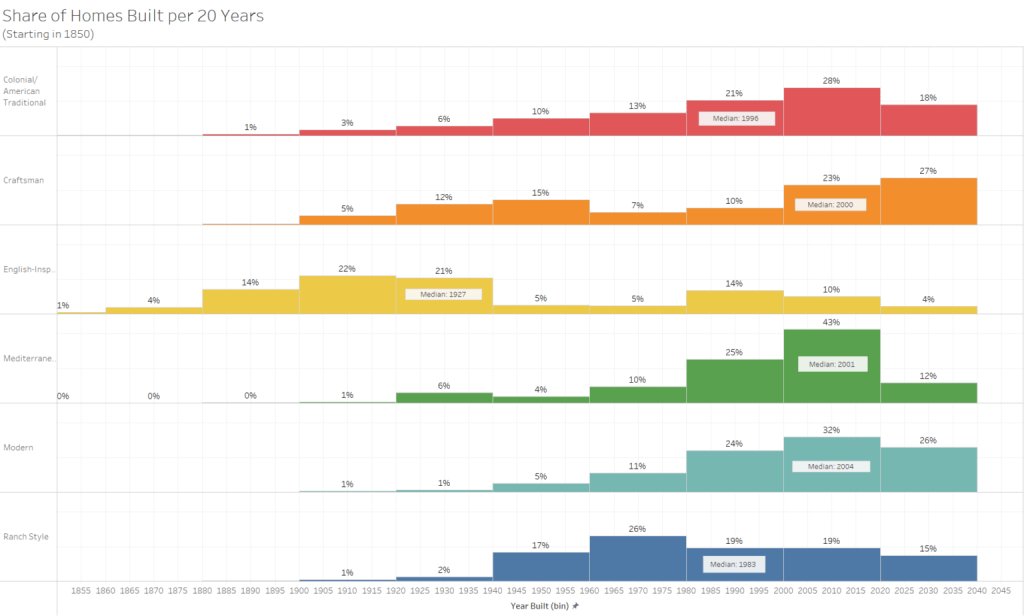
Different architectural styles track closely with different eras of U.S. housing development—and with different expectations of space.
English-inspired homes are the largest on average, with a median 2,700 SF footprint. Mediterranean homes follow close behind, typically clocking in at 2,500 SF. Ranch homes are the smallest at 1,700 SF, reflecting their mid-century, postwar roots. Modern and Craftsman styles tend to hover near the national median of 2,048 SF, often reflecting newer infill construction or high-end custom builds.
The median year built for active listings is now 1995, but there’s wide variation:
English homes are oldest (median year: 1927) Ranch homes mostly date to the 1980s Colonial: 1996 Craftsman: 2000 Mediterranean: 2001 Modern: 2004
This age spread influences not only buyer appeal, but also renovation risk, inspection outcomes, and long-term maintenance costs.
💰 Price and Appreciation: Who’s Gaining, Who’s Stalling
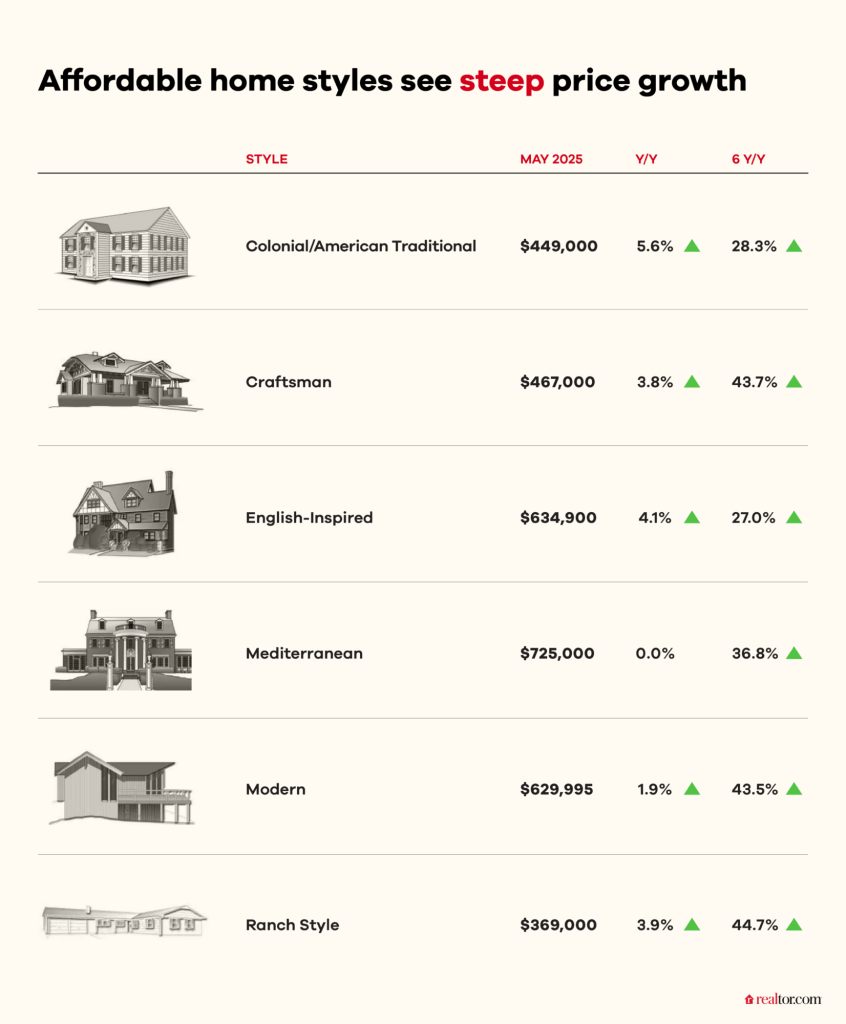
Style isn’t just a design choice—it’s a price signal.
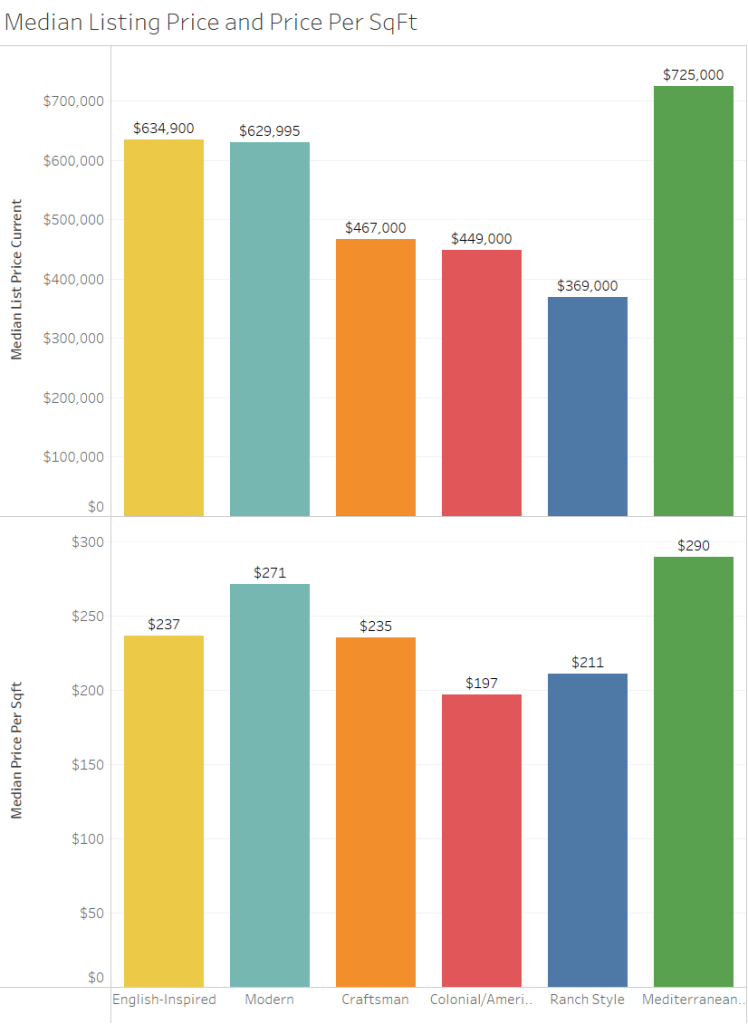
Mediterranean and European-style homes top the charts with a median price of $725,000. Ranch homes sit at the bottom, priced more affordably at $369,000. Modern and Craftsman homes fall somewhere in between, often commanding a premium on a price-per-square-foot basis thanks to newer construction and urban infill locations.
But price isn’t everything. Appreciation matters more for long-term value—and that’s where things get interesting:
Over the past 6 years, U.S. home prices jumped 41.3%, with 2% annual growth on average. Colonial/American Traditional homes saw the strongest 1-year appreciation at +5.6%. Mediterranean homes flatlined, with 0% growth over the past year, reflecting softening luxury demand in the West and South. Since 2019, Craftsman, modern, and ranch homes appreciated most—each up around 44%. English-inspired homes saw the slowest long-term growth at just +27%.
The takeaway? High-cost homes in expensive metros aren’t appreciating as quickly in this environment. Rising ownership costs and policy uncertainty have pushed demand toward affordability. The market is speaking clearly: buyers want value and practicality more than ornate flourishes or sprawling floorplans.
🧠 Final Thoughts: What Style Signals for Investors and Developers
As someone who lives and breathes design, development, and market dynamics, here’s what I’m taking from the data:
Affordability wins. Styles associated with smaller footprints and practical layouts (like ranch and Craftsman) are not only selling but appreciating faster. Premium inventory needs precision. If you’re building or repositioning a Mediterranean or modern product in LA or Miami, execution is everything. The margin for error is razor thin. Design can’t be divorced from context. What sells in Phoenix isn’t what sells in Boston. Knowing your buyer means knowing your region’s design language—and matching the right product to the right pocket.
Style is never just about aesthetics. It’s a proxy for pricing, for buyer psychology, for the era and environment in which a home was built. In this market, understanding architectural trends isn’t trivia—it’s strategy.
If you’re developing, marketing, or investing in housing today, pay attention to the rooflines, materials, and massing. They might just tell you everything you need to know about where the value is going.
 Daniel Kaufman Real Estate
Leave a comment