
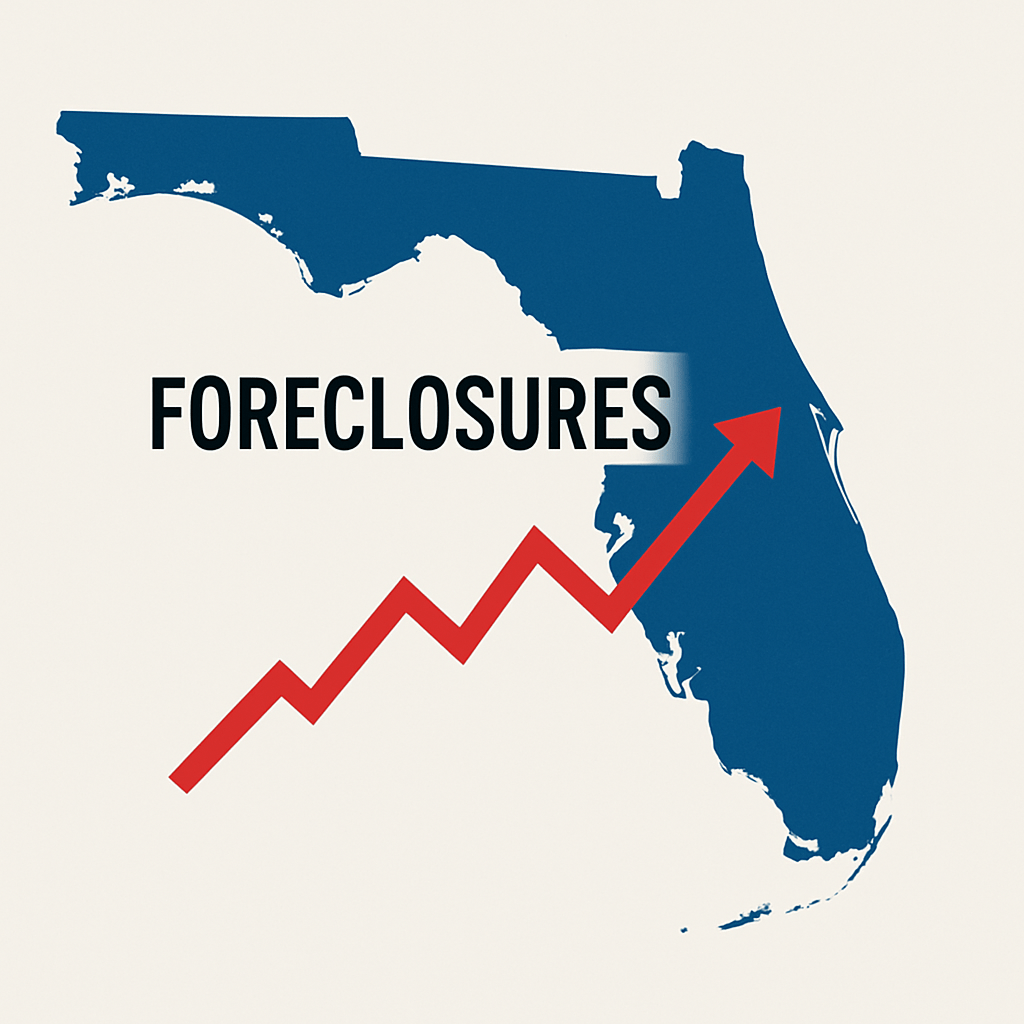
Foreclosures are back in the headlines—and this time, Florida is leading the nation.
According to ATTOM’s April 2025 U.S. Foreclosure Market Report, over 36,000 U.S. properties were hit with foreclosure filings last month—a modest 0.4% increase from March, but a more concerning 13.9% jump year-over-year. While national volumes remain below pre-pandemic levels, the steady rise in both starts and completions signals growing financial strain for U.S. homeowners.
But if there’s one state every real estate investor should be paying attention to right now, it’s Florida.
Florida’s Distress Signals Are Getting Louder
Florida ranks among the top three states with the highest foreclosure rates in the country—alongside South Carolina and Illinois—with 1 in every 2,526 housing units receiving a foreclosure filing. Even more telling? Florida had the second-highest number of foreclosure starts in the nation last month at 2,810 properties—second only to Texas.
For investors, this is a flashing red light. Florida’s triple threat—surging HOA dues, spiking insurance premiums, and mounting property tax burdens—has created an affordability squeeze that’s pushing more owners underwater. And with the median list price in the state hovering at $440,000, above the national median of $431,250, the pressure isn’t easing.
Add to that the fact that Florida counties remain heavily exposed to economic shocks, and it’s clear that more distress could be on the way.
Where the Risk Is Concentrated
Some of Florida’s most prominent secondary markets are now surfacing as foreclosure hotspots:
Ocala, FL: 1 in every 1,731 homes Palm Bay-Melbourne-Titusville, FL: 1 in every 1,753 homes
These are markets that investors flocked to during the Sun Belt migration boom of 2020–2022. But the exit of institutional capital and cooling buyer demand has shifted the dynamics. Many of these properties were overleveraged, overbuilt—or both.
And while REO activity is down slightly from last month (2.9%), it’s still up 23.3% from April 2024, signaling more inventory may be hitting the market soon.
What’s Driving the Rise?
The reality is that ownership costs are outpacing wage growth in many metros, especially in high-growth states like Florida. As ATTOM notes, housing costs are now consuming more than triple the share of average wages in some markets. That imbalance is unsustainable—and it’s showing up in the data.
Even traditionally resilient metros like Miami and Orlando are now seeing a spike in foreclosure starts, with Miami recording 739 new filings in April.
What Investors Should Be Watching Now
For institutional buyers, family offices, and opportunistic funds, this moment offers a unique opening. Foreclosures don’t just reflect distress—they also signal re-pricing in overheated markets. Investors who understand how to navigate complex workouts, acquire REOs, or structure JV deals with distressed sellers have a tactical advantage.
But proceed with discipline: many foreclosures come with title issues, unpaid liens, or deferred maintenance. In today’s landscape, due diligence isn’t optional—it’s your edge.
Final Thought: Florida Is Becoming a Barometer
Foreclosure data is more than just a headline—it’s a market signal. And Florida, with its mix of overexposure, investor pullback, and rising ownership costs, may be the canary in the coal mine for other Sun Belt markets.
The smart capital is watching what happens next in Florida—and preparing to act accordingly.
Daniel Kaufman
Real Estate Investor | Developer | Strategic Advisor
 Daniel Kaufman Real Estate
Leave a comment