
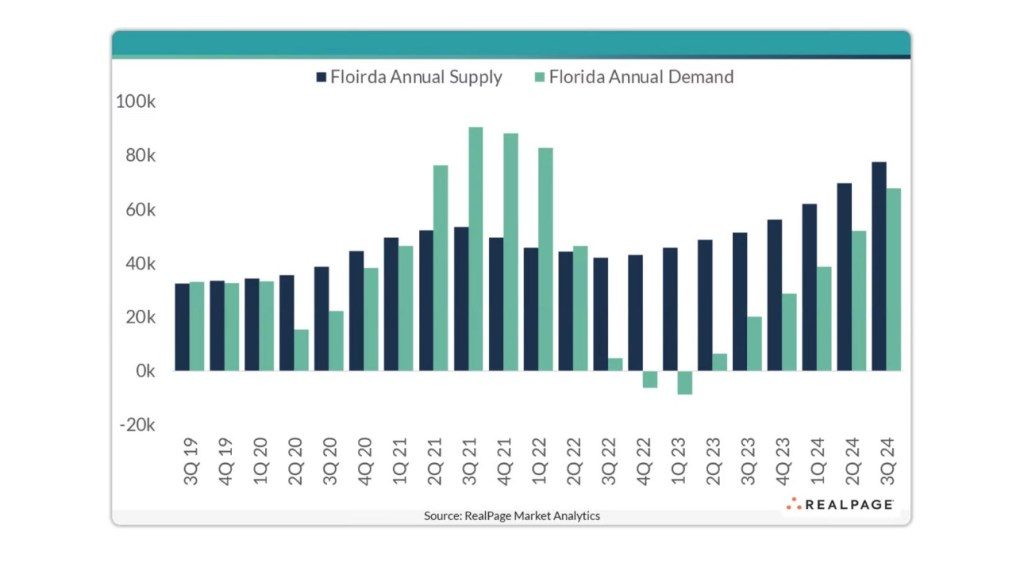
Florida’s apartment market has roared back to life, with demand and supply growth reinforcing the state’s status as a prime destination for migration and investment. In recent years, Florida has experienced a unique growth trajectory, shaped by shifting work and lifestyle patterns that show no sign of cooling off.
Big Picture: The Migration Boom and Florida’s Appeal

Florida was a clear beneficiary of pandemic-driven migration trends, as remote work allowed people to seek sunnier, lower-cost alternatives. Many flocked to both urban centers and smaller markets across the Sunshine State, leading to peak demand in 2021. Though demand softened in 2023, it has roared back in 2024, as Florida’s appeal endures.
Record Supply Meets Resurgent Demand
In the year ending Q3 2024, developers delivered over 77,600 apartment units across Florida, marking the highest annual delivery count tracked by RealPage Market Analytics. This figure far exceeds Florida’s five-year average of 48,700 units annually, cementing its place as a national leader in apartment construction.
As of Q3, demand surged to nearly 68,000 units—coming close to the record supply growth. Florida’s apartment market is, therefore, not only meeting population influxes but doing so with a pace and scale that few other states can match.
Market Hotspots: Where Demand Is Highest

Several cities have emerged as hotspots, with nine of the 30 fastest-growing apartment markets in the U.S. located in Florida. Secondary markets such as Lakeland, Cape Coral, and Sarasota have seen strong occupancy gains, reflecting rising appeal in smaller cities. By contrast, traditional college towns like Gainesville and Tallahassee have experienced slower growth due to limited new construction.
Key Takeaway for Investors and Developers
Florida’s apartment market is a case study in balanced growth, with supply mirroring booming demand fueled by population growth. As Florida’s housing market remains hot, secondary markets are increasingly competitive, and occupancy rates are strong in areas beyond the state’s larger urban centers. For real estate investors and developers, this sustained growth offers an intriguing opportunity to expand into markets that are not only seeing population gains but also positioning themselves as national leaders in multifamily housing.
What does this mean for your investment strategy? Are you considering secondary markets? Let’s discuss the opportunities in Florida’s evolving real estate landscape.
 Daniel Kaufman Real Estate
Leave a comment