
In today’s data-driven world, understanding demographic and population trends is crucial for supporting new developments and addressing economic challenges. These insights help allocate resources more efficiently and design more sustainable communities.

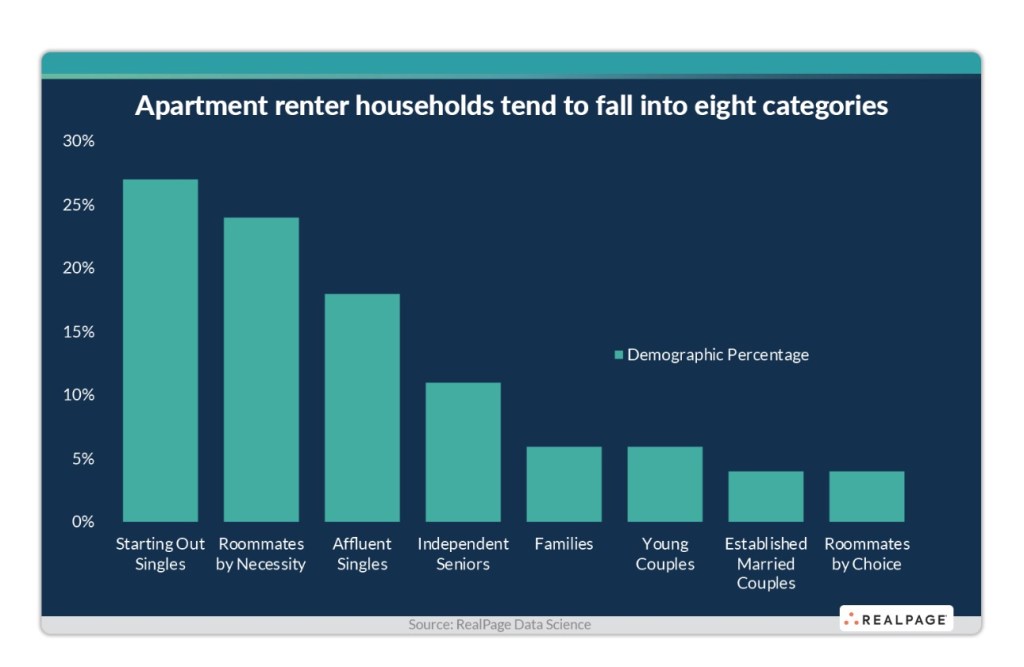
The study reveals that the typical U.S. apartment renter is 31 years old, earns approximately $73,000 annually, and lives in a 900-square-foot unit. While this provides a useful baseline, the analysis delves deeper, categorizing renters into eight distinct groups. The largest group, Starting Out Singles, comprises 27% of all apartment renter households. This demographic, with a median age of 26 and an annual income of $48,000, leases the smallest units and spends the highest percentage of their income on rent (27%). Despite tight budgets, these renters prefer living alone in Class B or Class C properties.
Starting Out Singles are particularly sensitive to price increases and are more willing to rent properties with lower online reputation scores (ORA). This group faces significant challenges during economic downturns, as seen post-pandemic and during inflationary periods, when many transitioned to other cohorts. Together, these two groups represent over half of the nation’s renter households.
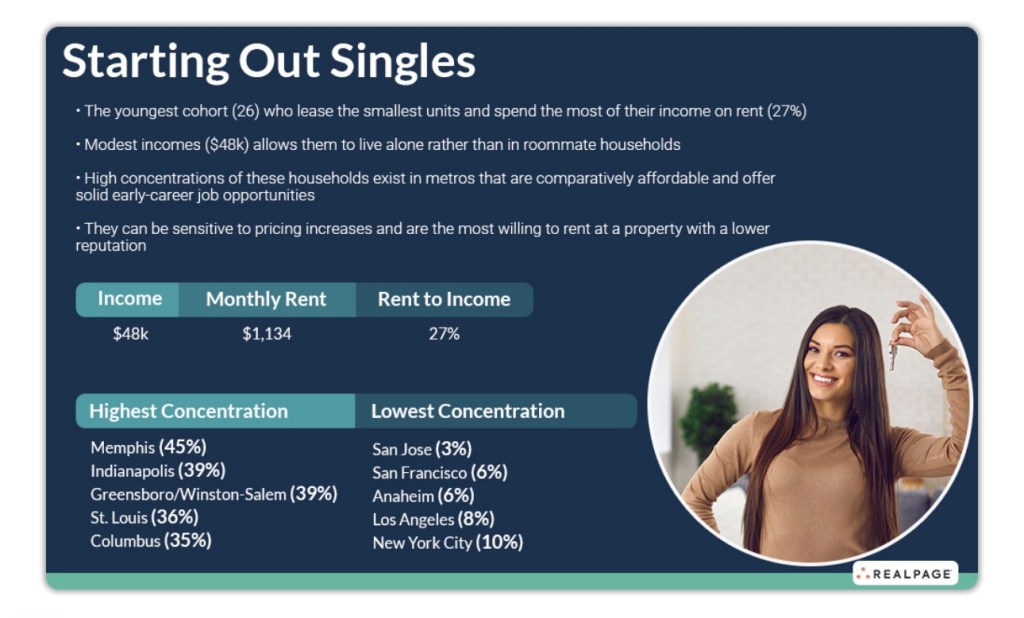
High concentrations of Starting Out Singles are found in Midwest markets and slower-growth Sun Belt areas, with leading metros including Memphis (45%), Indianapolis (39%), and Greensboro/Winston-Salem (39%). Fast-growth Sun Belt metros like Atlanta, Dallas, and Houston also attract many Starting Out Singles due to early career opportunities.
Conversely, this demographic forms a smaller share of the renter mix in coastal gateway markets, where high living costs make solo living less feasible. In the Bay Area (5%), Los Angeles (8%), and New York City (10%), Starting Out Singles are relatively rare.
.
 Daniel Kaufman Real Estate
Leave a comment